

It is the desire of the School of Medicine Office of Faculty Recruitment, Affairs and Development for faculty to succeed in Tenure and/or Promotion. Our office is here to assist faculty through this process.
Tenure & Promotion Timelines
-
2025-2026 Tenure & Promotion Timeline Date Action March 13, 2026 Tenure/Promotion notification letters sent to all Campus Department Chairs & Faculty via Workflow Manager. March 27, 2026 Deadline for submission of department list of names for tenure/promotion to the Office of Faculty Recruitment, Affairs & Development. REQUIRED: The candidate furnishes the Campus Department Chair with five names that can be contacted for Academic letters of reference. It is the responsibility of the Campus Department Chair to obtain letters of reference from at least three but no more than five references and submit these letters to the Office of Faculty Recruitment, Affairs and Development, via Workflow Manager, by July 15th. OPTIONAL REFERENCE LETTERS: In addition to the required academic letters, the candidate may request up to 3 confidential letters from colleagues (not in the candidate’s department) who can speak to their area of excellence (clinical, scholarly, OR teaching). It is the responsibility of the candidate to request the letters and ask that the letters be submitted directly to the Office of Faculty Recruitment, Affairs and Development no later than July 15th. (See Procedures for Tenure & Promotion for further details.) July 15, 2026 Deadline for submission of all tenure/promotion documents by the Campus Department Chair to the Office of Faculty Recruitment, Affairs & Development via Workflow Manager. July 22-August 5, 2026 Review by Department Tenure/Promotion Committee; submission of ballots to the Office of Faculty Recruitment, Affairs & Development via Workflow Manager. August 11-31, 2026 Review by Campus Department Chair for his/her submission of ballot & letter of recommendation; all documents forwarded to the Office of Faculty Recruitment, Affairs & Development via Workflow Manager. September 4-28, 2026 (Deliberate October 2, 2026) Review by School of Medicine Tenure and Promotion Committee. October 8-30, 2026 Review by School of Medicine Dean. November 2026 Review by Provost. December 2026 Review by President. January 2027 Review by Chancellor. February/March 2027 Consideration by Board of Regents. -
- March: Tenure/Promotion notification letters sent to all Campus Department Chairs & Faculty.
- April: Deadline for submission of department list of names for tenure/promotion to the Office of Faculty Recruitment, Affairs & Development (OFRAD).
- July: Deadline for submission of all tenure/promotion documents by the Campus Department Chair to the OFRAD.
- July/August: Review by Department Tenure/Promotion Committee; submission of ballots to the OFRAD.
- August: Review by Campus Department Chair for his/her submission of ballot & letter of recommendation; all documents forwarded to the OFRAD.
- October: Review by School of Medicine Tenure and Promotion Committee.
- October: Review by School of Medicine Dean.
- November: Review by Provost.
- December: Review by President.
- January: Review by Chancellor.
- February/March: Consideration by Board of Regents.
Tenure & Promotion Workshop Dates
The Office of Faculty Recruitment, Affairs and Development offers workshops to help faculty navigate the T&P process, including timelines, application preparation and Workflow Manager training. RSVP for a workshop or request one-on-one training by emailing cristina.robertson@ttuhsc.edu.
Workshop Dates Coming Soon
2026–2027 Tenure & Promotion workshop dates will be posted as they are scheduled. Please check back for upcoming opportunities.
- 11:11 AM (CST)
Responsibilities Involving Application
The Tenure &/or Promotion applicant and the applicant's Department Chair have specific responsibilities when it comes to the Tenure & Promotion process.
-
- Notify the Office of Faculty Recruitment, Affairs and Development (OFRAD), via Workflow Manager, the name(s) of the candidate(s) being considered for promotion &/or tenure.
- Obtain confidential letters of reference from at least three (3), but no more than five (5) individuals. If the candidate does not know three to five academic colleagues, the Chair along with the candidate can identify individuals who can be asked to evaluate the candidate's CV using the appropriate table from the SOM Faculty Tenure and Promotion policy.
- Requirement for these letters can be found in the Initial Steps and General Timeline for Promotion/Tenure (SOM OP 20.21.A)
- Templates for these letters can be found on the Faculty Forms page under the Tenure & Promotion tab.
- Submission of the signed application to the SOM Office of Faculty Recruitment, Affairs and Development through Workflow Manager:
- The Final Application with signed signature page incorporated into the electronic document (.pdf format). All appendices in the order listed in the appendices section of the application (.pdf format). The appendices should be attached to the application, and uploaded as 1 document. The appendices are not to be separate from the application.
- An electronic version (.pdf format) of the 3-5 confidential academic reference letters. These letters should be uploaded to Workflow Manager in the appropriate section specifically dedicated to the Required Academic Reference Letters.
-
- Inform your Department Chair of your decision to apply for promotion or tenure using Workflow Manager.
- Supply an updated CV (not your T&P application) to your Department Chair. They will include this CV with the request for Required Academic Reference Letters.
- Supply 3-5 names, addresses and email addresses of the individuals to whom the Chair will need to request the Required Academic Reference Letters. If you do not have 3-5 individuals, discuss with your Department Chair.
- Optional Area of Excellence Reference Letters: Three (3) additional, optional reference letters can be solicited by the faculty, from colleagues not in the faculty's department who can speak to their area of excellence (clinical, scholarly, OR teaching). Optional reference letters are to be emailed or addressed to the TTUHSC School of Medicine, Office of Faculty Recruitment, Affairs and Development, som.facdev@ttuhsc.edu or 3601 4th Street, STOP 6213, Lubbock, Texas 79430.
- An electronic version (.pdf) of the completed SOM Application for Tenure &/or Promotion Report run from Faculty Success.
- All appendices should be attached to the application in one .pdf file format, in the order listed in the appendices section of the application.
- The signature page with the faculty member's signature.
Tenure &/or Promotion Packet Requirements
-
The SOM Tenure &/or Promotion Application is generated from Faculty Success.
- To access a video tutorial with instructions on running reports from Faculty Success, please click here. (Make sure you select "SOM Application for Tenure and/or Promotion, and use the date range of January 1, 1925 - December 31, of the current calendar year.)
- To access Faculty Success, click here.
The first page of the report you generate should resemble this:
Image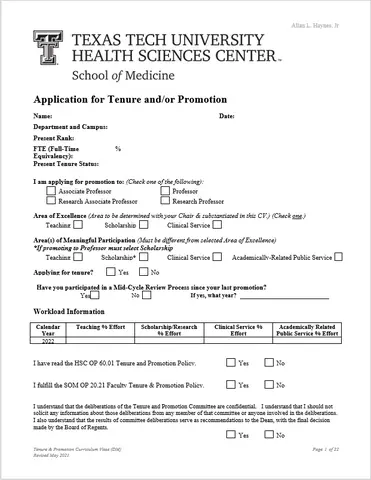
Things to remember and helpful tips for successful application completion:
First things first...If you have entered information into Faculty Success and it is not populating on the report in the location you think it should, it could be due to entry error. I highly recommend a review of the Faculty Success Workshop. You can view the recording at your own pace and it will help you with proper data entry, thus, fewer mistakes in reporting.
- You will have 3 faculty members not in your department who will review your application for the SOM T&P Committee. Therefore, as you complete your application, remember to be specific since these faculty may not be familiar with your specialty.
- All information, past and present, should go into Faculty Success, and therefore this application. Anything you have done since your undergraduate degree.
- It is highly recommended to read the gray boxes above each section. These boxes give the exact details of the type of information needed in each section, as well as give you ideas for the types of information which can be added to each section.
- Remember your area of excellence and area(s) of meaningful participation when you are entering data. Make sure your area of excellence has the most data to prove why that is your area of excellence. Same for area(s) of meaningful participation. Also, make sure your workload % match your excellence and meaningful areas (e.g. your highest % should align with your area of excellence & your 2nd highest should be your area of meaningful participation).
- Once you have everything in the correct place, it may leave the General Information section somewhat empty. That’s okay. The T&P Application is broken down into sections (General Information, Teaching, Scholarship/Research, Clinical Service, Academically-Related Public Service). You want the main sections filled out more so than “General Information.” Remember #4!
- Do NOT use abbreviations. Remember, there will be 3 faculty members who are not in your department who will be reviewing your application. If they are unfamiliar with abbreviations for your specific field, they will have to look them up to see what you are talking about. This can be tedious and time consuming for reviewers. Examples:
- APS could be written as “American Pediatric Society (APS)…or…
- APS could be written as “American Physiological Society (APS)”
- Spell out all states, or abbreviate all states. Whichever you choose, make the application consistent for aesthetics.
- If you have many items listed in multiple sections, BEWARE! Where overlapping activities for a couple of items is okay, excessive repetition tends to have the committee asking why the applicant felt the need to list things in multiple places. If you list them in multiple places you need to give an explanation as to why you chose to duplicate each entry. Otherwise, the committee looks at it as though the applicant is trying to "pad" their application. Be careful with this. Try to keep in mind your area of excellence and your area of meaningful participation, and fill those areas with as much as possible. The committee looks to those areas you have listed as Excellence & Meaningful as areas of primary dedication.
- Anytime you have the opportunity to give an explanation about something, DO IT! How did you mentor that student/resident/faculty member/etc.? What was that award for? What are your responsibilities within the committee? etc.
- With regard to presentations and publications (this can be a bit confusing, so if you have questions, please feel free to contact our office):
- If a work gets published, you should only list it in the Publications section.
- If a work is a presentation (poster/abstract/oral presentation/virtual presentation, etc.) which is then published in the journal for that sponsoring organization, only list it as the publication. The committee views a publication has “higher esteem” over a presentation. They are aware of the work that goes into publishing a paper/abstract/etc., and they know you most likely presented it prior to having it published.
- If you completed a presentation for 1 venue (say, CREOG Annual Meeting, or American Physiological Society) and it gets published in a different organization's journal (say, the Placenta or Nature), then you would enter it both in publications and presentations. Also, if you present a work that gets presented multiple times at the same conference, but different years, you get to enter that each time you presented it.
- If you have clinical service activities, when you’re filling out the clinical practice section, make sure to put all practices you’ve been involved with (personal or teaching) with the dates of service and a description of each. You can put each location into both sections (personal and teaching) as long as the description you put with each talks about that section (talk about teaching in the teaching section and personal practice in the personal practice section).
- Don’t forget to manually type in the areas that do not auto-populate from Faculty Success. These sections are listed below:
- Page 1: All of the check boxes
- Teaching Section: 4.b. Add in your Number of hour of direct instruction/supervision for the most recent academic year
- Appendices Page
- Signature Page
- If any section says 100 words or less, this is a guideline. Do not dictate 6 pages of explanations. Keep your summary concise, yet detailed.
- Do not leave boxes blank. If you have nothing to add to a particular section/box, the manually type "None at this time," or "None" so the reviewers understand you did not accidentally miss a section.
- Once you are satisfied with your application, go back through and “clean it up.” Pay attention to capitalization, spelling, grammar, font, etc. Be consistent with your documentation so it is esthetically pleasing. This application reflects your efforts as a clinician, basic scientist and academician.
-
Along with the application itself, faculty have both required and optional documents which must/can be added to provide specific examples of faculty activities.
Near the end of the application is a page titled "Appendices." There are four (4) specific sections:
- Teaching Activities
- Faculty have the opportunity to add 4 types of teaching documents to highlight exceptional activities indicated throughout their application. Specific details of each can be seen on the application's appendices page.
- Student/Resident Teaching Evaluations
- Course Materials Developed
- Student/Resident Letters of Appreciation
- Continuing Professional/Medical Education Evaluations
- Faculty have the opportunity to add 4 types of teaching documents to highlight exceptional activities indicated throughout their application. Specific details of each can be seen on the application's appendices page.
- Scholarship
- Faculty will have the option to add no more than three (3) peer reviewed scholarly works.
- Clinical Service
- Faculty will have the opportunity to add no more than three (3) UNSOLICITED letters from colleagues or grateful patients that speak to their clinical practice, or comments from patient satisfaction surveys.
- Optional Letters of Reference (discussed in next section)
- Teaching Activities
-
All letters of reference are CONFIDENTIAL, and are not to be seen by the faculty member.
Required Academic Letters of Reference:
3-5 letters must be received by the School of Medicine, Office of Faculty Recruitment, Affairs and Development from the Department Chair by application due date (mid-July). Templates for these letters can be found on the Faculty Forms page under Tenure & Promotion. The campus Department Chair, along with the faculty member, can identify individuals for whom academic reference letters will be solicited.
- A minimum of 3 letters, but up to five letters must come from another academician, not employed by TTUHSC, who are at or above the rank desired (if applicant is applying for tenure, the letter must be from a tenured academician).
- All letters must be on letterhead and signed by the author, either as handwritten or authenticated electronic signature. Academic reference letters from the following list are deemed acceptable and are listed in order of regard as determined by the SOM Tenure and Promotion (T&P) Committee:
- Letters from the following are acceptable:
- Letters will be deemed acceptable if the author is established within a medically affiliated college or school (e.g. schools of medicine, health professions, pharmacy, nursing, biological sciences, etc.), at or above the rank aspired, or tenured if applying for tenure.
- Blind letters (not known to candidate) from academicians at or above the rank aspired, or tenured if applying for tenure.
- Faculty member that has been at an academic institution, including TTUHSC, and left or retired within the last 10 years. During their employment at their affiliated institution, they must have been at or above the rank desired by applicant, or tenured if applying for tenure.
- If the letters do not meet the minimum requirements addressed above, a sub-committee of the SOM Tenure and Promotion committee, comprised of the current Chair and/or Vice-Chair and additional members assigned, will review the submitted letters and determine if the letters are acceptable according to the above-mentioned guidelines, or administratively withdraw the applicant’s dossier due to lack of required documents.
- These individuals should be supplied with:
- The faculty member's updated CV (not the Tenure/Promotion application)
- SOM OP 20.21
Optional Area of Excellence Letters of Reference:
Only the first three (3) letters received by the School of Medicine, Office of Faculty Recruitment, Affairs and Development by mid-July of the participation year, will be included in the faculty's application. To find a template for this letter, email som.facdev@ttuhsc.edu.
- The faculty member will seek out and request letters from colleagues not in the faculty's department who can speak to their area of excellence (clinical, scholarly, or teaching). These letters are to be addressed and sent to the Office of Faculty Recruitment, Affairs and Development at the following address or via the following email:
TTUHSC School of Medicine
Office of Faculty Recruitment, Affairs and Development
3601 4th Street, STOP 6213
Lubbock, Texas 79430
- Letters from the following are acceptable:
- TTUHSC faculty NOT in the faculty member's department
- Faculty from other TTUHSC Schools
- Community Physicians
- Collaborative individuals from other institutions (including other Texas Tech University System's Institutions)
Mid-Cycle Review Process
Learn how the Mid-Cycle Review Process evaluates faculty progress toward promotion and tenure and prepares you for future advancement.
-
Faculty facing promotion and/or tenure in TTUHSC School of Medicine departments should have a prior assessment of their progress toward their goals. To that end, each department may perform a mid-cycle review of faculty. All reviews shall address cumulative accomplishments in teaching, scholarship, clinical service and academically-related public service. The review is intended to be informative and encouraging to faculty who are making solid progress toward tenure and/or promotion, instructional to faculty who may need to improve in selected areas of performance, and cautionary to faculty where progress is significantly deficient. The aim of the review is to provide information that will assist the non-tenured faculty member seeking promotion and to the tenure-track faculty member seeking promotion and/or tenure while there is time for changes in orientation and activity, if needed, of the individual involved.
Per SOM OP 20.21.A, faculty wishing to pursue promotion and/or tenure must either complete a MCR since their last promotion/tenure attempt (regardless of the outcome), OR attend a Tenure & Promotion Workshop held by the Office of Faculty Recruitment, Affairs and Development (OFRAD) within one year of submitting their application.
NOTE: Faculty who participate in the Mid-Cycle Review Process CANNOT participate in the Tenure and Promotion Process in the same year. Instead, they must wait until the following year before participating in the Tenure and Promotion process.
-
The Associate Dean for the OFRAD will determine a timetable for each newly hired faculty member with regards to the approximate year of the tenure/promotion decision and the midpoint of that term. For example, the maximum probationary period for awarding tenure is seven (7) years. Therefore, the midpoint should be no later than three (3) years. However, faculty can request a mid-cycle review at any time, including follow-up reviews.
January
Invitation emails are sent to all faculty deemed eligible to participate. Eligibility is determined by the Associate Dean for Faculty Recruitment, Affairs and Development (OFRAD).March
Final applications are due to OFRAD.March
Departmental review committees complete their reviews through a web-based application.June/July
The Associate Dean of OFRAD reviews all ratings and comments and emails each applicant an individualized review along with final comments from the departmental review committee. -
The Office of Faculty Recruitment, Affairs and Development tracks faculty promotion and tenure outcomes in relation to participation in the Mid-Cycle Review process.
The data below demonstrate promotion and tenure outcomes for faculty who participated in Mid-Cycle Review compared with those who did not.
Mid-Cycle Review Study Statistics
Mid-Cycle Review Study Statistics Year Total Candidates Went through MCR Promoted and/or tenured % Successful with MCR No MCR Promoted and/or tenured % Successful w/out MCR 2016-17 20 12 12 100% 8 7 88% 2017-18 38 18 17 94% 20 14 70% 2018-19 33 14 12 86% 19 12 63% 2019-20 21 12 9 75% 9 9 100% 2020-21 31 21 19 90% 10 8 80% 2021-22 25 10 10 100% 15 10 67% 2022-23 32 16 15 94% 16 11 69% 2023-24 33 19 18 95% 14 10 71% 2024-25 22 16 16 100% 6 5 83%
Meet the Team
We're here to help. Contact us!

Tina Bratcher Robertson
Director - Faculty Affairs SOM

Office of Faculty Affairs & Development
School of Medicine
- Email som.facdev@ttuhsc.edu