


Immigration Information
Immigration Information
Please use the tabs below for information on topics and services.
It's very important that your I-20 be accurate. Please contact your Designated School Official (DSO) if you make any changes to your academic program, such as a change in major or level of study.
It's also important that you pay attention to the program end date on your I-20. If you need more time to complete your program, you will have to apply for an extension.
Students transferring to TTUHSC in F‑1 status must have maintained valid F‑1 status and currently hold an active SEVIS record. After you are admitted to a TTUHSC program, work with the international office at your current school to release your SEVIS record to the correct TTUHSC school code. Once your SEVIS record is released, TTUHSC will issue a transfer-pending I‑20. Upon arrival on campus, you are required to report to a TTUHSC DSO and complete F-1 immigration check-in. Failure to report may result in termination of your SEVIS record.
TTUHSC School Code
- Lubbock - DAL214F61188000
- Abilene - DAL214F61188005
- Amarillo - DAL214F61188006
- Dallas - DAL214F61188001
*If you plan to travel outside the United States during your school transfer process, contact our office in advance. You may be required to re-enter the U.S. using your TTUHSC I‑20 with a valid travel signature.
Transferring from TTUHSC to another university requires your SEVIS record to be released to the new institution. To initiate this process, please provide your DSO with your admission letter from the new school and a completed SEVIS release form.
If you are currently in a different visa status and intend to change to F‑1, you have two options: you may travel outside the United States and apply for an F‑1 visa to re-enter in F‑1 status, or you may apply for a change of status through USCIS while remaining in the U.S. Both processes can be complex. If you need F‑1 status to pursue full‑time study in an academic program, please consult with our office for guidance before deciding how to proceed.
Curricular Practical Training (CPT) makes it possible for F-1 students to gain specific practical work experience required by an established degree program. Such training must be an integral part of the curriculum, and the student must be receiving academic credit. It provides legal authorization for the F-1 student to be in a work environment whether or not payment of wages is involved. Required internships, practical and other work requirements as listed in TTUHSC School catalogs are examples of such programs. In certain circumstances, graduate students who must work for an employer while doing thesis or dissertation research might qualify for CPT. Questions concerning the appropriateness of CPT in specific situations should be addressed to your Designated School Official (DSO).
A student must have been in F-1 status for an academic year to be eligible for CPT. A graduate student whose degree program requires a practicum to begin immediately may be eligible for an exception to this rule. In certain circumstances, time spent in full-time study in another immigration status may count toward satisfaction of the rule.
Curricular Practical Training is authorized by an International Student Counselor with an endorsement on your I-20 form. No application to DHS or an EAD card is required. The I-20 endorsement provides specific dates for beginning and ending authorization and specifies the employer and site of work. The endorsement must be obtained before work begins.
Curricular Practical Training can be either full-time (more than 20 hours per week of work), which does require at least a minimal enrollment, or part-time (up to 20 hours per week of work), which requires full-time enrollment. Full-time CPT of 12 months or more makes F-1 students ineligible for subsequent Optional Practical Training.
Application Procedures
- Obtain an employer letter from the company that is offering you the position.
- Obtain an academic advisor's Letter for Curricular Practical Training on letterhead providing required CPT information. Required information includes a description of the work experience, name of employer, beginning and ending dates of employment, and an explanation of how the experience will be monitored and graded. (Use this letter template for both the employer and academic advisor.)
- Obtain a new I-20 with the CPT authorization on page two from your DSO.
What is Optional Practical Training (OPT)?
Post-Completion Optional Practical Training is a type of work authorization that allows F‑1 students to work in the U.S. after finishing their degree. It provides up to 12 months of full‑time employment related to their major field of study.
How long can I do OPT?
You may receive up to 12 months of OPT at each higher degree level. Students in STEM fields may qualify for an additional 24-month STEM OPT extension; for details, please visit our STEM OPT page.
When can I apply for OPT and How?
An application for post-completion OPT can be filed up to 90 days prior to the student's program completion date and no later than 60 days after the student's program completion date.
How long does the OPT Application process take?
Processing times vary and can change without notice, so please refer to the current
timeline on the USCIS website. Select Form I‑765, category F‑1 Academic Student (c)(3), and the service center SCOPS to view the relevant estimate.
Applying for OPT
Step 1: Learn about OPT
Watch the OPT video by clicking on the link below.
Step 2: Obtain I-20 with OPT recommendation from your Designated School Official (DSO)
Once you have watched the linked OPT Presentation above and are ready to apply for the OPT, you will need to complete the following documents and email them to your DSO. The I-20 with OPT recommendation (the I-20 you will need to file OPT application) will be issued and provided to you after your DSO reviews and approves these documents:
- Academic Advisor's Statement of Program Completion Form. You will need to make an appointment with an academic adviser in your department to determine when your academic program will end. Your academic adviser will have to fill out and sign the Academic Adviser's Statement of Program Completion Form.
- The OPT Acknowledgment Form, which shows your understanding of the OPT regulations and your intent to follow them.
Step 3: File your OPT application and wait for your EAD card
Once you receive the I-20 with OPT recommendation from your DSO, you will need to create a USCIS online account.
Once you have made the application fee payment and received your payment confirmation, your application is completed. USCIS will send your EAD card and any other relevant documents to the mailing address you provided to them. It is critically important that you keep USCIS informed of any address changes. If you change your mailing address while OPT application is pending, you must inform USCIS through your online USCIS account or at the USCIS website.
Remember, you can't start working until you have your EAD card and until the start date on the EAD card.
Biometrics Appointment & RFE
You may receive a biometrics appointment notice and/or a request for evidence (RFE) after submitting their OPT or STEM OPT application. If you are assigned a biometrics appointment, USCIS will mail you a notice and upload it to your online account; it will list the date, time, and location of your required visit to a local Application Support Center, along with instructions for rescheduling or changing the location. An RFE asks for additional documents or information needed to continue processing your case. Missing a biometrics appointment or failing to respond to an RFE can jeopardize your application.
What is STEM OPT Extension?
STEM OPT is the 24‑month extension of Optional Practical Training available to certain F‑1 students in STEM fields. It’s essentially a way for eligible students to continue working in the U.S. for two additional years after their initial 12‑month post‑completion OPT.
How long can I do STEM OPT?
Science, technology, engineering, and math (STEM) students are eligible for an extension of 24 months (2 years) of OPT, meaning that the total of optional practical training can be 3 years.
When can I apply for STEM OPT?
The student must already be on Post-completion OPT. They may apply for the STEM OPT extension up to 90 days before their OPT EAD expires, and USCIS must receive the application before the OPT end date. Students cannot apply after their OPT expires.
How long does the STEM OPT Application process take?
USCIS may take 2–4 months to process a STEM OPT application, and current I‑765 processing times can be checked on the USCIS website. Because timelines vary and can change without notice, students should apply as early as possible. Those who file on time receive an automatic 180‑day extension of work authorization past the OPT EAD end date while the case is pending, but they must stop working once the 180‑day period ends if the application is still not approved.
Applying for STEM OPT
We encourage students to apply online and strongly discourage students from filing the paper application.
Step 1: Learn about STEM OPT
Watch the STEM OPT video by clicking on the link below.
Step 2: Obtain I-20 with STEM OPT recommendation from your Designated School Official (DSO)
Once you have watched the linked STEM OPT Presentation above and are ready to apply for the STEM OPT Extension, you will need to complete the following documents and email them to your DSO. The I-20 with STEM OPT recommendation (the I-20 you will need to file STEM OPT application) will be issued and provided to you after your DSO reviews and approves these documents:
- Completed STEM OPT Acknowledgement Form - This form outlines all the regulations and information you need to know about STEM OPT. Although this form is not needed in your online application, TTU International Affairs requires it to ensure you understand STEM OPT guidelines.
- Completed I-983 Form - This form must be filled out by you and your employer. Please use the I-983 Guide to assist you with each section. Remember that your employer must be e-verified and employment must be related to your degree and 20 or more hours a week.
Step 3: File your STEM OPT application and wait for your EAD card
Once you receive the I-20 with STEM OPT recommendation from your DSO, you will need to create a USCIS online account.
Once you have made the application fee payment and received your payment confirmation, your application is completed. USCIS will send your EAD card and any other relevant documents to the mailing address you provided to them. It is critically important that you keep USCIS informed of any address changes. If you change your mailing address while STEM OPT application is pending, you must inform USCIS through your online USCIS account or at the USCIS website.
Remember, those who file on time receive an automatic 180‑day extension of work authorization past the OPT EAD end date if the case is pending.
Biometrics Appointment & RFE
You may receive a biometrics appointment notice and/or a request for evidence (RFE) after submitting their OPT or STEM OPT application. If you are assigned a biometrics appointment, USCIS will mail you a notice and upload it to your online account; it will list the date, time, and location of your required visit to a local Application Support Center, along with instructions for rescheduling or changing the location. An RFE asks for additional documents or information needed to continue processing your case. Missing a biometrics appointment or failing to respond to an RFE can jeopardize your application.
F‑1 students may work on campus at TTUHSC while enrolled full time and maintaining valid F‑1 status. Your TTUHSC I‑20 serves as proof of work eligibility for TTUHSC student employment only. On‑campus employment includes positions paid by TTUHSC that directly support the student community, such as teaching assistant, research assistant, and library student worker.
Students may work up to 20 hours per week during the fall and spring semesters. Although immigration regulations allow full‑time work during official breaks, TTUHSC may limit student employees to 20 hours per week year‑round. On‑campus employment eligibility ends when you graduate, transfer (on your SEVIS release date), or fall out of status.
On‑campus student job opportunities can be found through the TTUHSC website or departmental postings. Students are responsible for understanding and following employment regulations. Violating F‑1 employment rules can result in the loss of F‑1 status and may require difficult communication with USCIS.
International students and scholars in the United States must report their income, including scholarship, regardless of whether they are paid by the school or receive no income at all. TTU and TTUHSC provide GLACIER Tax Software for non-resident employees and students for free. GLACIER Tax Prep is only for non-resident alien tax returns. Resident aliens must file the same tax forms as U.S. citizens. Direct all GLACIER-related questions to the Texas Tech Tax and Compliance Office.
TTU and TTUHSC do not prepare tax returns or offer individual tax advice.
F‑1 students who fail to maintain status become out of status and are expected to depart the U.S. immediately; otherwise, they begin accruing unlawful presence. Immediate action is essential—contact your international advisor to determine whether reinstatement or departing and re‑entering the U.S. with a new SEVIS record is the best option. A new I‑20 is required in either case. Remaining out of status without action can result in denial of future immigration benefits and re‑entry to the U.S. Consult your DSO for guidance.
If you cannot depart the U.S., you may apply for reinstatement through USCIS only if you meet all eligibility requirements:
- Enrolled full‑time
- No unauthorized employment
- Out of status for fewer than five months
- Able to show the violation occurred due to circumstances beyond your control
While a reinstatement application is pending, F‑1 benefits such as on‑campus employment are not available.
Our office may refuse to issue a reinstatement I‑20 in cases of serious misconduct (e.g., criminal behavior). Students in such situations must leave the U.S. and re‑enter to regain F‑1 status.
An F‑1 student’s spouse and children may qualify for F‑2 status. F‑2 dependents may:
- Study part‑time at TTUHSC or another university
- Travel internationally with or without the F‑1 student
- Enroll in elementary or secondary school (children only)
F‑2 dependents cannot work or enroll in full‑time study. To issue an F‑2 I‑20, our office requires proof of sufficient funding and a passport bio page for each dependent. With the F‑2 I‑20, dependents may apply for F‑2 visas at a U.S. consulate and must demonstrate financial support and intent to return home; visa approval is not guaranteed. After arriving in the U.S., F‑2 dependents must report to our office with their immigration documents. For additional details, visit the Study in the States webpage and consult your DSO for guidance.
Immigration regulations permit F‑1 students to enroll in less than a full course load only under very limited circumstances. These circumstances include:
- Documented medical reasons
- Initial difficulty with the English language or reading requirements
- Unfamiliarity with U.S. teaching methods
- Improper course‑level placement
- Completion of studies (i.e., the student’s final semester)
This list is exhaustive; no additional exceptions are allowed. Dropping a course because it is “too difficult,” or due to concerns about GPA, scholarships, or personal preference, does not qualify for a Reduced Course Load (RCL). Students should plan their schedules carefully with this in mind.
For additional guidance or to request an RCL, please consult the RCL request form.
International Student Services is unable to provide direct financial assistance to our international students. Please work with your specific School and the Office of Student Financial Aid.
Our office does not issue letters for students who want to invite family or friends to visit them here in the US. This is because the Department of State does not consider these letters in its decision to issue tourist visas, as stated below:
“Note: Visa applicants must qualify based on their ties abroad/to their home country, rather than assurances from U.S. family and friends. A letter of invitation or Affidavit of Support is not needed to apply for a visitor visa. If you choose to bring a letter of invitation or Affidavit of Support to your interview, please remember it is not one of the factors used in determining whether to issue or deny the visa." US Department of State
However, students may choose to write letters on their own behalf to confirm their relationship to a family member or friend, as well as providing a formal invitation to visit. The family member may also choose to provide supporting documents, such as a birth certificate. Template for one of these letters.
F‑1 students can apply for an SSN only after receiving on‑campus employment. You must obtain an employment offer letter from a TTUHSC department and a status‑confirmation letter from your designated school official (DSO).
A Texas driver’s license is an official document issued by the Texas Department of Public Safety (DPS) that allows you to legally operate a motor vehicle in the state of Texas. To obtain one, you need to provide proof of lawful presence, Texas residency, identity, SSN (if applicable), and evidence of Texas vehicle registration and proof of vehicle insurance if you own a vehicle. The process involves passing a written knowledge test, a driving skills test, and a vision exam.
Before you apply:
- Study the Texas Driver Handbook.
- Bring your own insured vehicle for the road test.
- Ensure your name/address match across documents.
Documents to bring:
- Passport + Visa
- I‑94
- I‑20 or DS‑2019
- SSN card or sign SSN Affidavit
- Two Texas address proofs (lease, bills, bank statements, etc.)
At DPS:
- Take written + driving tests (fee covers 3 tries in 90 days).
- If your F-1 status can’t be verified, ask for SAVE verification.
Lubbock DPS Location: 1404 Lubbock Business Park Blvd #100 Hours: Mon–Fri, 8 am–5 pm
Texas ID card is not related to driving. It is useful as identification when a photo ID is required. There is a fee for this card. Texas ID can be applied for at the Texas Department of Public Safety (DPS).
You will need the following documents in order to make your application:
- Passport
- I-20
- Form I-94
- Completed application
- If you have a Social Security Number (SSN), present your Social Security card at the time of application. However, an SSN is not necessary to apply for a Texas ID.
- You may be asked to show two items proving your current address, such as a lease or piece of mail with your name and address (cable, gas, or electric bills are good choices). To avoid difficulties at DPS, ensure that your address matches on each document, including the room or apartment number.
Lubbock DPS Location: 1404 Lubbock Business Park Blvd #100 Hours: Mon–Fri, 8 am–5 pm
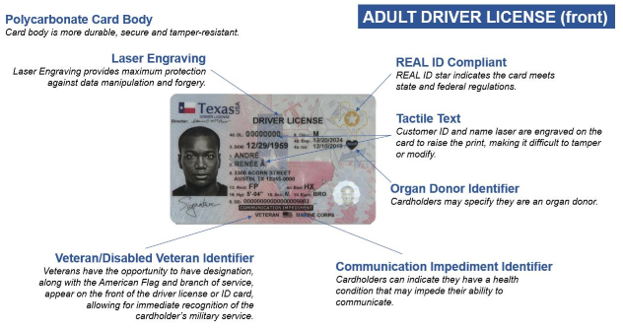
The Texas Department of Public Safety (DPS) now issues only driver licenses and identification cards that comply with federal REAL ID requirements. To verify their identity, applicants for a Texas driver license or identification card are generally required to present two forms of identification, including at least one government-issued photo ID.
Understanding REAL ID and How to Check If You Have a REAL ID:
Flip your driver’s license or state ID over – or just look in the top-right corner. If you see a star, you're good to go. If you don’t, it’s time to act.
Initial Application – Important Information:
For an initial Texas Driver License (DL) or Texas ID application, DPS requires a valid
passport and any unexpired US visa stamp as proof of identity. If you already have
a valid Texas ID card, it may be used in place of an expired US visa stamp (If an
applicant presents an unexpired U.S. visa, DPS uses the DHS SAVE program to verify
lawful presence before issuing the credential).
Renewal Application – Important Information:
For a Texas driver license renewal, DPS requires a valid passport and either a valid
Texas driver license or Texas ID card, or a valid U.S. visa stamp, as proof of identity.
Please refer to the examples of acceptable identity documents below.
Moving to Texas? Transfer-In Students with a Driver’s License and Vehicle Should Know:
New Texas residents can usually drive with a valid out-of-state license for up to
90 days, but must obtain a Texas driver license and register their vehicles in Texas.
Before applying for a Texas driver license or identification card, individuals must
first transfer their vehicle registration and auto insurance coverage to Texas. Most
applicants from other U.S. states (and some countries with reciprocity agreements)
can transfer their license without taking written or driving tests. https://www.dps.texas.gov/section/driver-license/moving-texas-guide-driver-licenses-and-ids
Examples of Acceptable Identity Documents:
- Unexpired passport
- Unexpired/expired US visa stamp
- Texas REAL ID-compliant Texas ID or Driver’s license
- Valid EAD
- For visa-exempt applicants: valid passport and I-94 as proof of identity.
Resources:
Texas Real ID: https://www.texas.gov/driver-services/texas-real-id/
DL or ID card application: https://www.dps.texas.gov/section/driver-license
Driving privilege reciprocity allows a person to use a valid, unexpired foreign license to operate a motor vehicle in Texas for up to one year: https://www.dps.texas.gov/section/driver-license/driving-privilege-reciprocity
International Driving Permit resources: https://www.aaa.com/vacation/idpf.html
Verifying Lawful Presence DPS Handout: https://www.dps.texas.gov/internetforms/Forms/DL-53.pdf
Going home for the summer or planning a trip for spring break? New to TTUHSC and wanting to learn about applying for your first F-1 visa? On this page, you'll find links to information about entering the U.S. in F-1 status. We want your travels to be as safe and trouble-free as possible. Travel regulations, visa procedures, and re-entry requirements can change with little notice, and unexpected delays may affect your return to the U.S. Check travel advisories and consult your DSO about any travel-related questions or concerns before your travel.
Basic Processes
Getting a Re-entry Travel Signature on your I-20
To re-enter the United States as a continuing F-1 student, you must have a valid travel signature on your Form I-20. Your DSO can issue this signature electronically upon request by email with a travel letter. When traveling, carry your valid passport, valid F-1 visa, signed I-20, a travel letter, and your most recent I-94 record.
How to Get a New Visa
When your visa has expired or when you are entering the US for the first time, you will need to visit a US Embassy or Consular office to get a visa entry stamp in your passport.
Special Processes
Travel to Mexico, Canada, and the Caribbean
Things that you need to know about traveling to Mexico, Canada, and adjacent islands. You can travel with an expired visa under particular circumstances. To view details, go to our Mexico and Canada travel page.