


Program Overview
The overall goal of the Cardiology Fellowship is to provide broad training in the disciplines of cardiology, focusing on the general competencies put forth by the American Council for Graduate Medical Education (ACGME).
The primary goal of the Interventional Cardiology Fellowship is to train future leaders in the field of interventional cardiology. The fellowship program provides the opportunity to acquire procedural expertise.
It is our desire that you become a competent, well-rounded interventional cardiologist who will provide quality patient care in whatever area you choose to practice. It requires a combined effort of hard work and a desire to learn on your part as well as stimulation and careful supervision on the part of the faculty.
The duration of the fellowship is 12 months. All fellows completing Interventional Cardiology Fellowship training should have the clinical skills and overall medical competence necessary for certification of their clinical competence to the American Board of Internal Medicine, should demonstrate moral and ethical behavior, and should have a reasonable expectation of passing the certifying examination of the American Board of Internal Medicine.
The TTUHSC interventional cardiology fellowship is comprised of:
- Cardiac Catheterization Laboratory Experience and Procedural Techniques
- Outpatient Clinic
- Consultative Services
- Inpatient Service
- Research
- Conferences
- On-Call Experience
- Independent Reading and Studying
- Discussion and Interaction with faculty and other fellows
- Extramural Conferences and Training Programs
The fellow has only one rotation. He/she is responsible for pre-and post-operative care of the interventional patient as well as the procedure. Also, he/she is responsible for interpretation of non-invasive vascular studies. In addition, he/she will have one half-day continuity clinic per week.
As is expected of interventional cardiologists in “real world” practice, these experiences occur simultaneously throughout the interventional fellowship year. This allows the fellow to participate in all aspects of the care of a wide variety of interventional cardiovascular patients including pre-procedural assessment, diagnostic and interventional therapeutic procedures, post
procedural care in the hospital and long-term, and in research relative to the field. As the fellow learns and gains experience, it is expected that he/she will integrate this knowledge and finesse to become a complete, well rounded, competent interventional cardiology consultant.
Curriculum & Coursework
-
The interventional fellow will spend 5 days per week in the cardiac catheterization laboratories at UMC participating in diagnostic procedures and coronary and peripheral vascular therapeutic interventional procedures. ½ day per week will be spent in the outpatient clinic with the cardiologists. The other half of the clinic day will be devoted to research concurrent with cath lab responsibility. If fellow become involved in a research project that requires more time, one additional day may be devoted to research with three days in the cath lab, or other arrangements can be made for protected research time.
-
The Division of Cardiovascular Medicine provide numerous conferences to enhance the educational experiences of fellows. Interventional fellows are required to attend the Cath Conference (which includes Quality Assurance and Morbidity and Mortality Conference), Journal Club and Research Conferences, and Interventional Cardiology Board Review.
-
The call schedule is published on a monthly basis. The fellows make their own call schedule, with number of calls based on academic year. The fellow on call is responsible for all consults and CVICU admissions. The interventional fellow will be expected to take call 2 weeks per month. Interventional calls will be shared with the two third year fellows.
-
Interventions are performed by the interventional fellow and third year general cardiology fellows or faculty, as the procedures require experience.
The fellowship program provides the opportunity to acquire procedural expertise:
- Percutaneous transluminal coronary angioplasty
- Balloon angioplasty
- Stent deployment
- Rotational atherectomy
- Directional atherectomy (lower extremity)
- Laser atherectomy (lower extremity)
- Mechanical thrombectomy (lower extremity)
- Rheolytic trombectomy (lower extremity)
- Distal protection devices
- Carotid arterial intervetion
Fellows will learn techniques for percutaneous coronary intervention and other procedures:
- Percutaneous balloon valvuloplasty
- Percutaneous valve implantation/replacement
Clinical investigations include the use of novel devices for percutaneous treatment of coronary artery disease, non-coronary cardiac interventions, such as percutaneous valve replacement, drug-eluting stent studies, stem cell and angiogenesis factor treatment for patients with end-state coronary, and peripheral arterial disease and novel imaging technologies.
Fellows graduating from the one-year program will easily exceed the minimum ACGME requirement of 250 coronary interventions. Our curriculum meets the requirements specified by the American College of Cardiology (ACC) for interventionalists; and our high volume and high level of case complexity provide an excellent foundation to develop expertise as an independent operator.
How to Apply
Online Application
Apply only through the Electronic Residency Application Service (ERAS). Applications are not accepted by eMail.
Admissions Requirements
Our program participates in the National Residency Matching Program (NRMP) and is registered with Electronic Residency Application Service (Program ID 1414821121— July Application Cycle).
There are certain eligibility criteria which must be met to apply for the Interventional Cardiology fellowship training program:
- Must apply via the Electronic Residency Applicant Service (ERAS) and must enroll in the National Residency Matching Program (NRMP)
- Be of good professional character with at least three letters of recommendation attesting to your academic and personal qualifications
- Graduate of a U.S, or Canadian Medical School accredited by the Liaison Committee on Medical Education (LCME), or a medical school outside the United States and Canada with a current valid certificate from the Educational Commission for Foreign Medical Graduates (ECFMG)
- Graduate of an ACGME-accredited three-year internal medicine residency training program and three-year cardiology fellowship training program.
- Our program only sponsors J-1 visa
- Completion and pass all three U.S. Medical Licensing Examination (USMLE) steps
- The selection process stringently evaluates performance on the United States Medical Licensing Examination (USMLE), grades in preclinical or clinical courses, letters of recommendation, communication skills, and personal qualities
- The department does not discriminate on the basis of gender, race, age, religion, color, national origin, sexual orientation or veteran status
- Interviewing is conducted during the months of January and February.
One fellow is selected from a highly competitive field of applicants for the training program. The fellow is selected from among eligible applicants on the basis of their ability, academic credentials, aptitude, communication skills, intellectual and humanistic qualities, personal attributes (such as motivation and integrity), preparedness, and their ability to benefit from the program. These qualities may be accessed through the review of academic records, letters of recommendation, standardized test scores and other means, including interviews.
Applications will be accepted through January 15. Interviews will be scheduled based on review by the program director and interventional faculty.
Application Check List
- ERAS Application
- ERAS Addendum Form (only needed upon invitation for an interview)
- Personal Statement
- Curriculum Vitae (in chronological order with no gaps)
- Dean's Letter
- Medical School Transcript
- 3 Letters of Recommendation
- Notarized copy of Diploma (only needed upon invitation for interview)
- Program Director's Letter/Certification (if had previous residency training in the U.S.)
- Copy of State License (if applicable)
IMG (International Medical Graduates) Additional Requirements
- Only accepts J-1 Visa
- No US clinical experience required but is preferred
- Must have ECFMG certificate at interview
- Clerkship Affidavit (only needed upon interview invitation)
- Valid ECFMG Certificate (required BEFORE invited for interview)
- Authorization form for confirmation of ECFMG certification (only needed at interview)
TTUHSC does not accept H-1 Visas
Salaries
| Salaries for 2026-2027 (These amounts are for the Lubbock Campus only) | |||||||
|---|---|---|---|---|---|---|---|
| PGY-1 | PGY-2 | PGY-3 | PGY-4 | PGY-5 | PGY-6 | PGY-7 | PGY-8 |
| $67,474 | $68,999 | $71,178 | $74,419 | $76,628 | $78,840 | $81,052 | $83,483 |
| Previous Years' Salaries | |||||||
|---|---|---|---|---|---|---|---|
| Year | PGY-1 | PGY-2 | PGY-3 | PGY-4 | PGY-5 | PGY-6 | PGY-7 |
| 2025-2026 | $65,764.23 | $67,250.96 | $69,374.62 | $72,532.92 | $74,685.79 | $76,841.81 | $78,997.84 |
| 2024-2025 | $63,725.03 | $65,165.66 | $67,223.47 | $70,283.84 | $72,369.95 | $74,459.12 | $76,548.30 |
| 2023-2024 | $61,570.07 | $62,961.99 | $64,950.21 | $66,936.99 | $68,923.76 | $70,913.45 | $72,903.14 |
| 2022-2023 | $58,918.73 | $60,250.71 | $62,153.31 | $64,054.53 | $65,955.76 | $67,859.76 | $69,763.77 |
| 2021-2022 | $57,202.65 | $58,495.83 | $60,343.02 | $62,188.87 | $64,034.71 | $65,883.26 | $67,731.82 |
| 2020-2021 | $55,536.56 | $56,792.07 | $58,585.46 | $60,377.54 | $62,169.63 | $63,964.33 | $65,759.05 |
Benefits
Malpractice Insurance
Aggregates are $100,000 per incident and $300,000 annual aggregate. Professional Liability Division website or call (806) 743-9921
Health Insurance
Group Health/Dental/Vision insurance for residents and eligible dependents.
Workers' Compensation
Workers' Compensation website
Vacation
Vacation is approved for not more than 15 working days for PGY 1 and 2 and not more than 20 working days for PGY-3 and above. Leave policies vary by program and may not apply to all programs. Program-specific leave details, including the number of days available, may be listed below.*
Leave Policies
Leave policies vary by program and may not apply to all programs. Program-specific leave details, including the number of days available, may be listed below.
- Sick leave for up to 12 working days per year. Leave policies vary by program and may not apply to all programs. Program-specific leave details, including the number of days available, may be listed below.*
- Family and parental leaves of absence (see also US Department of Labor Employment Standards Administrative - FMLA)
- Educational leave
- Military leave not to exceed 15 work days per year.
Retirement & Savings
Residents and fellows are not eligible for TTU System's 401K plan but can participate in the Optional Retirement Program (ORP) or the Tax-Deferred Account Program (TDA). More information will be provided upon starting your program.
For GME Salary and Benefits questions, please contact:
Lubbock Graduate Medical Education
Phone: (806) 743-2978
Fax: (806) 743-1599
Email: LubbockGME@ttuhsc.edu
*Each program sets their own vacation and sick guidelines, not to exceed the maximum.
Interventional Cardiology Fellowship Lubbock Specific Benefits
Eligible residents receive institutional health and welfare benefits and professional liability coverage.
Program support includes educational resources, conference/scholarly travel support, ACLS when completed through TTUHSC, lab coats, free parking, and meal-card support. Link to the current GME benefits page for authoritative details
Military/Veteran
Explore financial resources, benefits and support available to military members and veterans.
Additional Resources
-
Teaching Sites
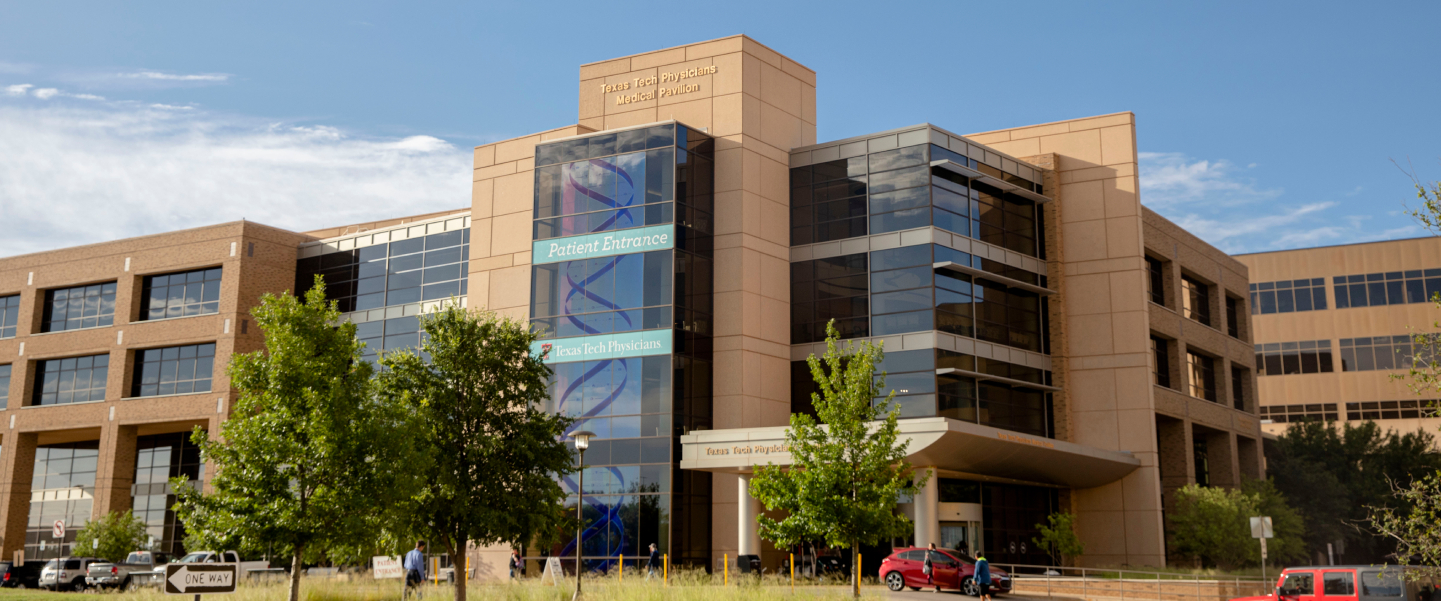
UMC- Our primary teaching hospital is University Medical Center (UMC), a county-supported tertiary medical facility offering a wide variety of services. Patients are referred from Lubbock and surrounding counties over a 200 mile radius, including eastern New Mexico.
Clinics
The Cardiovascular Center of Excellence is in the professional building located adjacent to Texas Tech University Health Sciences Center and is where the clinics are held weekly
Cardiology fellow clinic is held at pre-scheduled times. Patients are seen by the fellow and are presented to the faculty member for discussion and approval of planned management.
This a continuity clinic, so you follow your patient for the year you are a fellow.
Contact Us
Interventional Cardiology Fellowship Lubbock
We're here to help. Contact us if you have questions.
-
Address
3601 4th Street
Lubbock, TX 79430
United States
- Phone (806) 743-9580
- Email matt.molinar@ttuhsc.edu
-
Hours
8 a.m. - 5 p.m. Monday to Friday