


Program Overview
Our faculty are highly dedicated educators with extensive research and clinical experience in diverse settings. They are committed to being accessible and supportive mentors, working closely with students to develop the knowledge, skills, and professional competencies necessary for a successful career in occupational therapy.
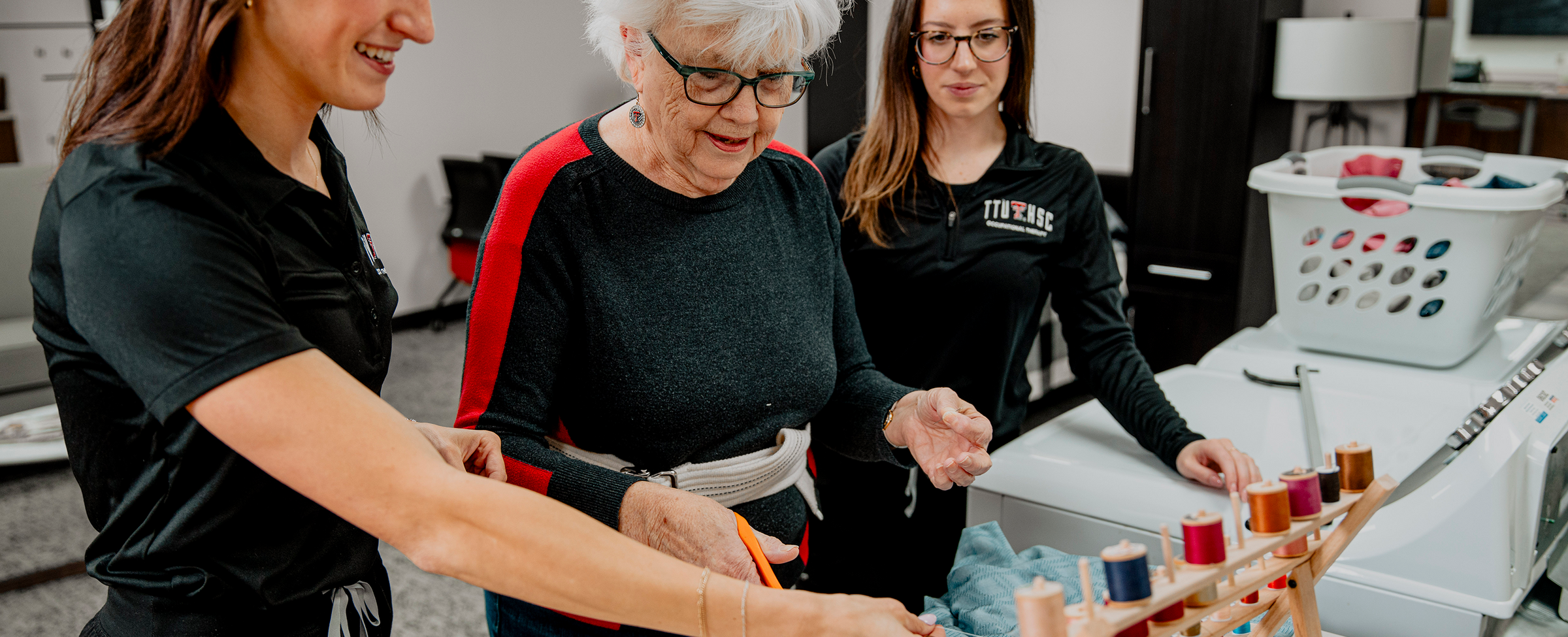
We are committed to providing an immersive, hands-on learning experience that bridges classroom instruction and real-world application. Throughout the program, you will assess clients in community settings, develop projects that promote community well-being, and work alongside faculty, practicing clinicians, and local agencies to connect academic knowledge with meaningful clinical experiences.
The entry-level occupational therapy doctoral (OTD) degree program (only offered on the Lubbock campus) is accredited by the Accreditation Council for Occupational Therapy Education (ACOTE) of the American Occupational Therapy Association (AOTA). Graduates will be eligible to sit for the national certification examination for the occupational therapist administered by the National Board for Certification in Occupational Therapy (NBCOT).
ACOTE
7501 Wisconsin Avenue
Suite 510E
Bethesda, MD 20814
Phone: 301-652-2682
ACOTE Website
For more information, please reach out to the Office of Admissions and Student Affairs at (806) 743-3220 or health.professions@ttuhsc.edu.
- 3 years estimated time to completion
- 55 estimated class size
Curriculum & Coursework
The curriculum prepares the student to enter the field of occupational therapy with a deep understanding of how engagement in occupation impacts health and well-being as well as a strong foundation in professionalism, critical reasoning, and practice skills.
The curriculum is a total of 100 semester credit hours across nine semesters during a three-year period. Successful completion of the academic, fieldwork, and capstone requirements leads to a Doctor of Occupational Therapy degree. Students complete semester credit hours that include classroom and lab instruction as well as a range of Level I Fieldwork experiences throughout the first two years of the program. Lab sections are intentionally limited in size to promote effective student-to-instructor engagement and provide high-quality instructional and clinical learning experiences. During the third year of the program, students complete: 24 weeks of full-time Level II Fieldwork; complete a doctoral capstone experience and project; and complete a final professional seminar course. No part of Fieldwork Level I may be substituted for any part of Fieldwork Level II. Students must complete all Level II Fieldwork as well as an individual 14-week capstone experience within 18 months following completion of the didactic portion of the program. The doctoral capstone experience must be started after completion of all coursework and Level II fieldwork as well as completion of preparatory activities defined in accreditation standards.
The majority of courses in the OTD curriculum use a face-to-face course delivery method. The distance education course delivery method is used for a few courses. The types of distance education course delivery methods (i.e., hybrid, online) are shown in the list below.
-
OTD Year 1 - Summer Semester Course Designation Credit Hours
HPOT 6210 Introduction to Occupational Therapy 2 hours
HPOT 6510 Human Anatomy 5 hours
Total Hours 7 hours
OTD Year 1 - Fall Semester Course Designation Credit Hours
HPOT 6220 Biomechanical Foundations (with non-credit lab) 2 hours
HPOT 6321 Occupation-Based Theories 3 hours
HPOT 6322 Occupational Therapy Process 3 hours
HPOT 6420 Evaluation: Developmental and Learning Models (with non-credit lab) 4 hours
Total Hours 12 hours
OTD Year 1 - Spring Semester Course Designation Credit Hours
HPOT 1002 Foundations of Interprofessional Collaborative Practice 0 hours
HPOT 6231 Professional Seminar I (Hybrid) 2 hours
HPOT 6330 Neurological Foundations 3 hours
HPOT 6332 Research I 3 hours
HPOT 6430 Intervention: Developmental and Learning Models I (with non-credit lab) 4 hours
HPOT 6431 Evaluation: Cognitive and Behavioral Health Models (with non-credit lab) 4 hours
Total Hours 16 hours
OTD Year 2 - Summer Semester Course Designation Credit Hours
HPOT 6240 Intervention: Developmental and Learning Models II (with non-credit lab) 2 hours
HPOT 6241 Evaluation: Biomechanical and Rehabilitative Models (with non-credit lab) 2 hours
HPOT 6341 Intervention: Cognitive and Behavioral Health Models (with non-credit lab) 3 hours
Total Hours 7 hours
OTD Year 2 - Fall Semester Course Designation Credit Hours
HPOT 6151 Professional Seminar II (Hybrid) 1 hour
HPOT 6250 Capstone 1: Project Development 2 hours
HPOT 6350 Research II 3 hours
HPOT 6450 Intervention: Biomechanical and Rehabilitative Models I (with non-credit lab) 4 hours
HPOT 6451·Evaluation: Motor Control and Motor Learning Models (with non-credit lab) 4 hours
Total Hours 14 hours
OTD Year 2 - Spring Semester Course Designation Credit Hours
HPOT 6260 Capstone 2: Project Proposal 2 hours
HPOT 6261 Professional Seminar III (Hybrid) 2 hours
HPOT 6361 Healthcare Management 3 hours
HPOT 6460 Intervention: Biomechanical and Rehabilitative Models II (with non-credit lab) 4 hours
HPOT 6461 Intervention: Motor Control and Motor Learning Models (with non-credit lab) 4 hours
Total Hours 15 hours
OTD Year 3 - Summer Semester Course Designation Credit Hours
HPOT 6970 Fieldwork II:1 9 hours
Total Hours 9 hours
OTD Year 3 - Fall Semester Course Designation Credit Hours
HPOT 6180 Capstone 3: Project Coordination (online) 1 hour
HPOT 6980 Fieldwork II: 2 9 hours
Total Hours 10 hours
OTD Year 3 - Spring Semester Course Designation Credit Hours
HPOT 6190 Professional Seminar IV (Hybrid) 1 hour
HPOT 6790 Capstone 4: Community Engagement & Implementation 7 hours
HPOT 6290 Capstone 5: Project Evaluation & Dissemination (Hybrid) 2 hours
Total Hours 10 hours
Combined Total Hours Credit Hours
CURRICULUM TOTAL 100 HOURS
-
OTD Year 1 - Summer Semester Course Designation Credit Hours
HPOT 6210 Introduction to Occupational Therapy 2 hours
HPOT 6510 Human Anatomy 5 hours
Total Hours 7 hours
OTD Year 1 - Fall Semester Course Designation Credit Hours
HPOT 6421 Biomechanical Foundations (with non-credit lab) 4 hours
HPOT 6321 Occupation-Based Theories 3 hours
HPOT 6322 Occupational Therapy Process 3 hours
HPOT 6420 Evaluation: Developmental and Learning Models (with non-credit lab) 4 hours
Total Hours 14 hours
OTD Year 1 - Spring Semester Course Designation Credit Hours
HPOT 1002 Foundations of Interprofessional Collaborative Practice 0 hours
HPOT 6231 Professional Seminar I (Hybrid) 2 hours
HPOT 6330 Neurological Foundations 3 hours
HPOT 6332 Research I 3 hours
HPOT 6430 Intervention: Developmental and Learning Models I (with non-credit lab) 4 hours
HPOT 6431 Evaluation: Cognitive and Behavioral Health Models (with non-credit lab) 4 hours
Total Hours 16 hours
OTD Year 2 - Summer Semester Course Designation Credit Hours
HPOT 6240 Intervention: Developmental and Learning Models II (with non-credit lab) 2 hours
HPOT 6241 Evaluation: Biomechanical and Rehabilitative Models (with non-credit lab) 2 hours
HPOT 6341 Intervention: Cognitive and Behavioral Health Models (with non-credit lab) 3 hours
Total Hours 7 hours
OTD Year 2 - Fall Semester Course Designation Credit Hours
HPOT 6250 Capstone 1: Project Development 2 hours
HPOT 6251 Professional Seminar II (Hybrid) 2 hours
HPOT 6350 Research II 3 hours
HPOT 6450 Intervention: Biomechanical and Rehabilitative Models I (with non-credit lab) 4 hours
HPOT 6451·Evaluation: Motor Control and Motor Learning Models (with non-credit lab) 4 hours
Total Hours 15 hours
OTD Year 2 - Spring Semester Course Designation Credit Hours
HPOT 6260 Capstone 2: Project Proposal 2 hours
HPOT 6261 Professional Seminar III (Hybrid) 2 hours
HPOT 6361 Healthcare Management 3 hours
HPOT 6460 Intervention: Biomechanical and Rehabilitative Models II (with non-credit lab) 4 hours
HPOT 6461 Intervention: Motor Control and Motor Learning Models (with non-credit lab) 4 hours
Total Hours 15 hours
OTD Year 3 - Summer Semester Course Designation Credit Hours
HPOT 6770 Fieldwork II:1 7 hours
Total Hours 7 hours
OTD Year 3 - Fall Semester Course Designation Credit Hours
HPOT 6280 Capstone 3: Project Coordination (online) 2 hours
HPOT 6980 Fieldwork II: 2 7 hours
Total Hours 9 hours
OTD Year 3 - Spring Semester Course Designation Credit Hours
HPOT 6190 Professional Seminar IV (Hybrid) 1 hour
HPOT 6790 Capstone 4: Community Engagement & Implementation 7 hours
HPOT 6290 Capstone 5: Project Evaluation & Dissemination (Hybrid) 2 hours
Total Hours 10 hours
Combined Total Hours Credit Hours
CURRICULUM TOTAL 100 HOURS
Admissions Requirements
An applicant's OTCAS application must be verified and all other requirements must be received by the deadline. Please note there is a lag in submitting your application to OTCAS and the application being verified. Applicants will need to plan accordingly. It is in the best interest of the applicant to apply as early as possible.
Official GRE Scores
The GRE is not required for the OTD program.
Bachelor's Degree
A Bachelor’s Degree from an accredited college or university is required for admission in addition to the specific prerequisite courses.
Minimum GPA
A minimum cumulative GPA of 3.0 on a 4.0 scale and a minimum science prerequisite GPA of 3.0 on a 4.0 scale is required. A competitive GPA is a consideration for admissions. A grade of C or better is necessary in each required pre-professional course.
Observation Experience
Applicants must have completed a minimum of 40 observation hours with a licensed occupational therapist prior to the application deadline. It is in the best interest of the applicant to complete a substantial number of experiential hours in occupational therapy, preferably in a variety of settings. This can be acquired in several ways: volunteer work, paid work and/or observation in occupational therapy settings/ services. Verification of observation/ experience hours in occupational therapy practice must be submitted as a part of the application. There is not a specific, printable form to submit; we suggest tracking your hours on a personal spreadsheet.
Letters of Recommendation
Three letters of recommendation are required. One letter must be completed by an occupational therapist. Letters should be completed by professional personnel who: (a) have observed you during any related volunteer or paid work, (b) are previous or present instructors and/or counselors, or (c) are previous or present employers. Letters of recommendation are submitted online through the OTCAS Application.
Personal Essay
An essay is required as part of the application.
International Applicants
All foreign coursework must be evaluated by a Foreign Credential Service. We also require TOEFL/IELTS Scores for any applicant for whom English is their second language (scores are considered on a case by case basis). Please refer to our International Applicants webpage for more information and TOEFL/IELTS exemptions.
Technical Standards
A student admitted into the TTUHSC Doctor of Occupational Program must meet basic and essential requirements that are necessary for obtaining employment and performing as an occupational therapist. A list of these technical standards can be found in the TTUHSC SHP Catalog in the OTD program section.
Prerequisite Coursework
All prerequisite courses must be complete prior to matriculation. It is recommended that prerequisite courses be taken within the last seven years. No more than 9 hours of prerequisites can be in progress and at least two science prerequisites must be completed for file to be reviewed. AP and CLEP credit will not be accepted for any science prerequisite course. There is no advanced placement, transfer of credit or experiential learning credit within the TTUHSC OTD Program.
| Course |
Credit Hours |
|---|---|
| Anatomy and Physiology (with lab) Note: Science Prerequisite Course |
6-8 hours |
| Physics and/or Biomechanics and/or Kinesiology Note: Science Prerequisite Course |
3 hours |
| Abnormal Psychology |
3 hours |
| Developmental Psychology (across the lifespan) |
3 hours |
| Statistics |
3 hours |
Application Process
Applications are considered on a rolling basis for acceptance into the professional program. The application must be verified by OTCAS and the TTUHSC SHP supplemental application must be complete by the application deadline. Individual applications are only reviewed after the OTCAS verification process is completed and the TTUHSC SHP supplemental application is submitted; therefore, it is in the applicant’s best interest to complete the application process, including submission of required documentation, as early as possible. Fulfillment of the basic requirements does not guarantee admission.
Interviews
Admission interviews are granted by the OTD admissions committee by invitation only. Invitations to interview with the OTD program faculty in Lubbock, Texas are extended to the most competitive applicants. Competitive applicants are selected for interviews based on a holistic evaluation of their application and supporting documents (cumulative GPA, science prerequisite GPA, volunteer/work experience in occupational therapy, recommendation letters, and student essay).
Immunizations and CPR
Verification of required immunizations and CPR for the Healthcare Provider certification must be submitted prior to enrollment in professional curriculum, or preferably by the application deadline. CPR certification must be maintained throughout the professional program. Immunizations will be maintained by the Office of Institutional Health. The program recommends CPR certification provided through American Heart Association as it is a common requirement for fieldwork sites.
Application Submission Checklist
- Online OTCAS Application
- Online TTUHSC SHP Application
- Application Fee
- Letters of Recommendation - Three required
Questions regarding the application process should be directed to the Office of Admissions and Student Affairs. Please contact our office by phone at 806-743-3220 or email at health.professions@ttuhsc.edu.
How to Apply
An applicant's OTCAS application must be verified and all other requirements must be received by the deadline. Please note there is a lag in submitting your application to OTCAS and the application being verified. Applicants will need to plan accordingly. It is in the best interest of the applicant to apply as early as possible.
Online Application
Applicants for the OTD program must complete both the OTCAS application and your personalized SHP supplemental application.
1. Start and complete the OTCAS application.
2. You must wait to receive this email before beginning your supplemental application. Do not go to the TTUHSC SHP website and attempt to access your supplemental application. The “start your application link” on the TTUHSC SHP website does not link to your personalized application.
If you did not receive your email, please check your junk email folder.
Please contact our Application Team with any questions at 806-743-3220 or shp.application@ttuhsc.edu
Application Fee
A non-refundable $75 application fee is required and may be paid by credit card through the online application system.
If you prefer to pay by check or money order, make it payable to TTUHSC and mail it to:
Office of Admissions and Student Affairs
3601 4th Street, MS 6294
Lubbock, TX 79430
Your application will move forward in the admissions review process after your application fee has been received.
Transcripts
Email PDF Transcripts: Submit official electronic transcripts from every college or university attended directly from the institution or an approved third-party transcript service to shp.application@ttuhsc.edu.
Please note: Do not send transcripts to Texas Tech University, as TTUHSC is a separate institution and doing so will delay application processing. Official TTUHSC transcripts are not required; official Texas Tech University transcripts are required.
Transcripts from international institutions must include an official course-by-course evaluation from a recognized Foreign Transcript Evaluation Service.
Applicants are responsible for ensuring all required application materials, including updated transcripts, are received by the application deadline.
Cost & Aid
Access information about tuition and fees, along with scholarships and financial aid resources, to help you plan and finance your education at TTUHSC.
Tuition & Fees
The following information is not intended to be comprehensive and is subject to change. Tuition, fees, and charges are subject to change by administrative, legislative, or regent action, and changes become effective on the date enacted. The following tuition information should be used only as a guideline for estimating charges.
|
Year 1 |
Year 2 |
Year 3 |
Total |
|
|---|---|---|---|---|
| Tuition |
$9,806 |
$10,086 |
$8,125 |
$28,018 |
| Fees |
$5,658 |
$4,500 |
$4,302 |
$14,461 |
| Total without Insurance |
$15,464 |
$14,587 |
$12,428 |
$42,479 |
| Student Health Insurance |
$3,917 |
$2,930 |
$2,930 |
$9,777 |
| Total with Insurance |
$19,381 |
$17,517 |
$15,358 |
$52,256 |
|
Year 1 |
Year 2 |
Year 3 |
Total |
|
|---|---|---|---|---|
| Tuition |
$23,981 |
$24,666 |
$19,870 |
$68,518 |
| Fees |
$5,658 |
$4,500 |
$4,302 |
$14,461 |
| Total without Insurance |
$29,639 |
$29,167 |
$24,173 |
$82,979 |
| Student Health Insurance |
$3,917 |
$2,930 |
$2,930 |
$9,777 |
| Total with Insurance |
$33,556 |
$32,097 |
$27,103 |
$92,756 |
Note: Students are charged a Student Health Insurance fee each term. If the student has qualified health insurance, a waiver can be applied through Student Life. Prices are subject to change.
Scholarships & Financial Aid
Our goal is to make obtaining a college degree within reach by supporting you with financial aid and scholarships programs. TTUHSC relies on a variety of financial aid sources to increase the university's affordability. This may include scholarships, grants, student loans, and waivers. As a student, please know that you and your family have a dedicated financial aid advisor who can assist you with this process.
Student Outcome Data
Occupational Therapy Certification
As a graduate of the program, you will be able to sit for the national certification examination for the occupational therapist administered by the National Board for Certification in Occupational Therapy (NBCOT) After successful completion of this exam, you will be an Occupational Therapist, Registered (OTR). In addition, all states require licensure in order to practice; however, state licensure is usually based on the results of the NBCOT certification exam. (Please note: A felony conviction may affect a graduate's ability to sit for the certification examination or attain state licensure.)
- 90% NBCOT first-time pass rate average for past 3 years (i.e., candidates passing on first attempt on the examination).
- 100% NBCOT annual pass rate average for past 3 years (i.e., candidates passing within one year of graduation, regardless of the number of attempts on the examination).
Outcomes (2023-2026)
| Graduation Year |
Students Entering |
Students who withdrew or did not graduate with entering cohort for reasons other than academic performance |
Students Graduating |
Graduation Rate |
|---|---|---|---|---|
| 2026 |
54 |
0 |
48 |
89% |
| 2025 |
53 |
0 |
49 |
92% |
| 2024 |
52 |
1 |
47 |
92% |
| 2023 |
53 |
2 |
49 |
96% |
| Totals |
212 |
3 |
193 |
91% |
Note: Graduation Rate is the number of students who graduated according to the published program length. If a student does not graduate according to the published program length, the student should not be counted as a graduate for ACOTE graduation rate reporting.



-
An integral part of the program curriculum, the Doctoral Capstone (DC) provides an in-depth exposure to one or more of the following areas:
- administration and leadership,
- program development and evaluation,
- education,
- practice skills,
- research skills,
- and advocacy.
It consists of two parts: (1) the capstone experience and (2) the capstone project.
Doctoral Capstone Experience (DCE)
The DCE develops occupational therapists with in-depth skills in one or more of the DC areas. The DCE occurs at a mentored practice setting known as the DCE site. The Doctoral Capstone Coordinator (DCC) will collaborate with the student to establish the DCE site and the required written agreement. During the DCE, the student is mentored by an individual with expertise consistent with the student’s DC area of focus. This mentor, known as the DCE site supervisor, does not have to be an occupational therapist. More than one student may be present and working collaboratively at the DCE site at the same time; however, each student will have individual capstone objectives and focus.
The 14-week (560 hours) DCE, beginning in January of the third year, must be completed after completion of all coursework, Level II fieldworks, and required preparatory activities (i.e., literature review, needs assessment, goals/objectives, and evaluation plan). The DCE is NOT a third Level II fieldwork. As such, the student will identify goals and objectives, requiring approval in advance of the DCE, to achieve the identified advanced skill and in-depth experience. The objectives for the DCE will overlap with the capstone project objectives; however, additional objectives and tasks specific to opportunities within the DCE site will also be developed. All DCE sites are located in the Lubbock area.
Image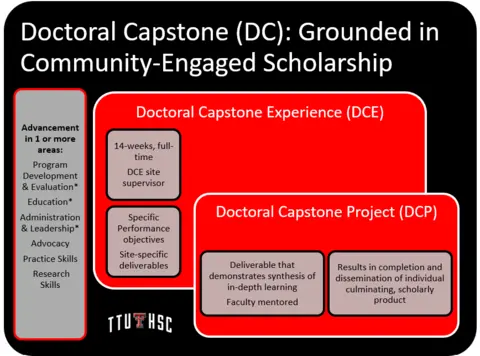
Doctoral Capstone Project (DCP)
The DCP develops occupational therapists’ capacities to engage in scholarly activities. The student completes an individual culminating product to demonstrate synthesis and application of knowledge gained in one or more of the DC areas. The DCP is a highly student-driven process; however, the student works in collaboration with a faculty capstone mentor and possibly a DCE site supervisor to develop an individual plan to achieve advanced learning objectives and produce evidence of scholarship.
The student engages in preparatory activities for the DCP during coursework and prior to the DCE that includes a literature review, needs assessment, goals/objectives, and an evaluation plan. The student must have an approved DC proposal prior to beginning the DCE. The student then engages in scholarship that supports the DCP during the DCE. Following the DCE, the student finalizes and disseminates their DCP. Examples of products that may document this scholarship include a presentation, case report, treatment manual, curriculum, grant proposal, quality improvement project report, program proposal or resource portfolio. Capstones requiring IRB processes will only be granted on joint projects with academic/professional research teams. The student presents their DCP at the TTUHSC OTD Research Symposium prior to graduation.
Program Contact for Doctoral Capstone Inquiries
For more specific questions, please contact the TTUHSC’s Doctoral Capstone Coordinator:
Laurie Stelter, OTR, PhD -
Fieldwork education is an integral aspect of our program. Students will be involved in Level I Fieldwork experiences during the first and second year in the program. Students complete 24 weeks of full-time Level II Fieldwork during the third year of the program.
In rare situations, a Level II fieldwork experience may be completed on a part-time basis to meet a student’s accommodation requirements or extenuating circumstances that are documented and approved by the AFWC and Program Director. A part-time placement must be at least 50% of a full-time equivalent that is determined by the fieldwork site’s usual and customary personnel policies and completed within no more than 24 weeks.
Fieldwork education consists of five experiences designed to prepare and expose the student to a variety of applied settings in occupational therapy:
- Level I experiences in pediatrics occur in association with HPOT 6240 Intervention: Developmental and Learning Models II in the Summer 2 semester. The student will actively participate in faculty-led learning experiences within the community to develop professional and therapeutic skills with the pediatric population.
- Level I experiences in mental health occur in association with HPOT 6341 Intervention: Cognitive and Behavioral Health Models in the Summer 2 semester. The student will actively participate in faculty-led learning experiences within the community to develop professional and therapeutic skills addressing behavioral, psychological, and social factors influencing engagement in occupation.
- Level I experiences in adult physical dysfunction occur in association with several courses over the first and second year. Integrated within these select courses, students apply knowledge to practice through participation in progressive comprehensive competency experiences relevant to practice in adult settings and understanding the needs of clients. Specific therapeutic competency experiences include the progressive use of simulated environments, standardized patients, and site visits.
- Fieldwork II 1: This full-time fieldwork experience typically begins in May of the third year and lasts 12 weeks. The student engages in an in-depth experience delivering occupational therapy services to clients, focusing on the application of purposeful and meaningful occupation, administration, and management of occupational therapy services.
- Fieldwork II 2: This full-time fieldwork experience typically begins in August of the third year and lasts 12 weeks. The student engages in an in-depth experience delivering occupational therapy services to clients, focusing on the application of purposeful and meaningful occupation, administration, and management of occupational therapy services. At least one of the two Fieldwork II experiences must be in an adult physical dysfunction setting. The other Fieldwork II experience may be in a different adult setting, a pediatric setting, mental health setting, or other specialist setting (e.g., hand therapy; neuro specialty).
Facilities that have occupational therapy clinical education agreements with TTUHSC may be used for Fieldwork sites. The Academic Fieldwork Coordinator provides detailed information for selection procedures. The student may provide preferences for certain setting types and for the location of Fieldwork II placements. The program has opportunities locally, across the state, and other states across the US.
Resources for Fieldwork Educators
Numerous resources for fieldwork education and supervision are available on The American Occupational Therapy Association (AOTA) website.
Program Contact for Fieldwork Inquiries
For more specific questions, please contact the TTUHSC’s Academic Fieldwork Coordinator:
Megan Taylor, OTR, OTD, CLT -
OTD Vision Statement
To earn recognition for elevating the practice of occupational therapy by promoting our distinct value as clinicians and professionals.
OTD Program Mission
To provide students with a strong foundation in professionalism, critical reasoning, and practice skills to become competent occupational therapists who use meaningful occupations to help people improve their health and well-being.
Philosophy Statement
The value of a profession lies within its professional identity and its distinct contribution to society. A deep understanding of the profession’s core subject is critical for the development of a strong professional identity and articulation of the profession’s distinct value. The core subject of the occupational therapy profession is the dynamics of occupation. Dynamics of occupation is a construct that characterizes how occupation—engagement in meaningful, necessary, and familiar activities—affects a person’s health and well-being. Dynamics are forces that influence growth, development, or change within a system or process. The dynamics of occupation can be understood as the forces related to occupational engagement that impact health and well-being.
Occupational therapists believe that being occupied in meaningful, necessary, and familiar activities is a source of health and well-being for human beings. These activities, or occupations, encompass areas that include: self-care, learning, work, play, leisure, social participation, and sleep/rest. Each person has a unique configuration of meaningful occupations that relate to their roles, habits, routines, contexts, and environments. Various life circumstances and health conditions can disrupt a person’s ability to engage in valued occupations.
Occupational therapists use their understanding of the dynamics of occupation to provide occupational therapy interventions that help people do the day to day activities that are important and meaningful to them. Occupational therapists work collaboratively with individuals, families, caregivers, and other groups whose life patterns and abilities to engage in valued occupations have been altered for various reasons (e.g., cognitive or developmental problems, injury or illness, social or emotional deficits, aging process). Occupational therapist apply critical reasoning and practice skills as they evaluate, plan, facilitate, and reflect on client care. The distinct value of occupational therapy is to improve health and well-being through facilitating participation and engagement in occupations at home, school, workplace, community, and various other settings.
Occupational therapy education must provide opportunities for students to integrate a wide range of topics learned to the core subject—dynamics of occupation—so that students profoundly understand and clearly articulate the distinct value of occupational therapy. Developing a deep understanding of the dynamics of occupations requires that students:
- Learn what constitutes an occupation and how to analyze activity demands
- Learn how to assess a person’s unique occupational profile
- Learn how to analyze occupational performance
- Learn how occupations can be disrupted, impoverished, or changed over time
- Learn how underlying neurological and physiological mechanisms that positively and negatively affect occupational engagement, performance, and participation
- Learn a therapeutic strategies, techniques, and activities to help people engage, perform, and participate in meaningful occupation
- Learn methods to evaluate changes in occupational participation, health, and well-being
-
A career in occupational therapy is a challenging profession that calls on the therapist to use clinical reasoning and creative skills to meet the unique needs of clients.
Occupational therapists use their clinical reasoning and therapeutic skills to implement a process of occupation-based evaluation and intervention in a variety of settings, including at home, in school, in the workplace, or in the community, a hospital, or clinic. For example, as an occupational therapist, you could help a child with autism participate fully in school and social situations; you could work with a person who is recovering from a hand injury so they can return to work; you could assist a person with mental illness in learning to manage a daily medication routine or help an older adult who experiences physical and cognitive changes following a stroke to resume household tasks.
- The Bureau of Labor Statistics Occupational Outlook Handbook projects that jobs in occupational therapy will grow by 14% from 2024-2034, much faster than average for all professions.
- For more information about the profession of occupational therapy visit the American Occupational Therapy Association (AOTA).
-
Program Director: Sandra Whisner, OTR, PhD, FAOTA
Request Information
Meet Our Faculty

Program Director, Associate Professor

Assistant Professor of Practice

Assistant Professor

Assistant Professor

Associate Professor
Assistant Professor

Professor

Assistant Professor of Practice

Associate Professor, Capstone Coordinator

Associate Professor of Practice, Academic Fieldwork Coordinator

Associate Professor
Contact Us
Office of Admissions and Student Affairs
School of Health Professions - Office of Admissions and Student Affairs
-
Address
3601 4th Street Lubbock
Lubbock, TX 79430
United States
- Phone (806) 743-3220
- Email health.professions@ttuhsc.edu
-
Hours
Mon. - Fri.
8 a.m. - 5 p.m.