


A Boost for Bright Minds

Cancer research has led to 18 million cancer survivors in the United States, according to the Association for Clinical Oncology. Still, hundreds of thousands of people are projected to die from the disease each year, and early-onset cancers among adults ages 18 to 49 are rising, according to the American Association for Cancer Research’s 2026 report.
The need for cancer researchers is clear, as their work could lead to the next generation of lifesaving therapies. That’s why the Medical Student Summer Research Program (MSSRP) at Texas Tech University Health Sciences Center (TTUHSC) partnered with the Rural Cancer Collaborative for the 2026 session.
“In the past three years, we’ve had less than a dozen research projects related to cancer,” Leslie Shen, Ph.D., associate dean for research in the School of Medicine and director of the MSSRP, said. “This year, we had 26 students working on cancer with different mentors in the 2026 MSSRP-Cancer program.”
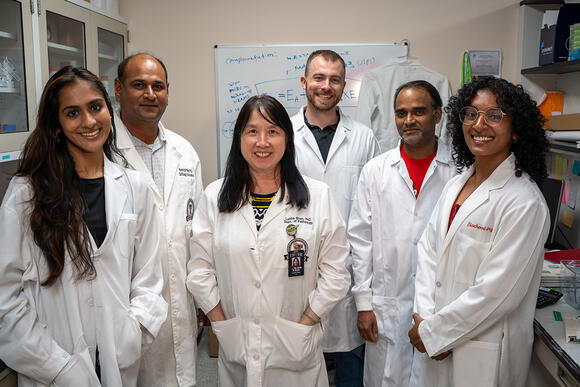
Hosted by the TTUHSC School of Medicine, the MSSRP is an 8-week summer elective for first-year medical students. For the 2026 session, the Rural Cancer Collaborative provided additional funding for cancer-related research projects.
“It’s always nice when we get extra support for these research initiatives,” Jordan Beal, MSSRP program coordinator, said. “With all the pressures of school, it’s hard sometimes to get the students encouraged enough to do the research. It was nice to say, ‘Hey, come on board; do this research with us,’ and see them really respond.”
In the 2026 MSSRP-Cancer program, Aisha Desouza was mentored by Komaraiah Palle, Ph.D., professor in the Department of Cell Biology and Biochemistry. She is the first medical student in her family and is now in her second year at the TTUHSC School of Medicine.
“I’ve been involved with this lab through MSSRP-Cancer this year,” Desouza said. “I had a little bit of history in cancer research. It’s been an interest of mine, and it was really nice to be able to understand it and learn from the highly educated people here in the cancer research lab.”
Desouza received a travel award from the Texas Society of Clinical Oncologists to present her research during the 2025 conference poster display. She also earned first place in her division during the 2025 TTUHSC Student Research Week organized by the Graduate School of Biomedical Sciences.
“It’s just so helpful to gain deeper insight into some of the concepts that we learn in med school,” Desouza said. “We really dive in here, especially in the oncological and immunological departments.”
“I’m very interested in continuing cancer research,” Desouza continued. “I’m still figuring out where I want to be in terms of a type of physician, but I think I would want to be involved in cancer research regardless.”
Niyati Babaria is also a second-year student in the School of Medicine. She earned her master’s degree in microbiology from Texas Tech University in 2024 and connected her master’s defense to her research project in Palle’s lab.
“Specifically, I did my master’s defense in cervical cancer, so I wanted to continue that,” Babaria said. “I was grateful to be given the opportunity to do so. I was more interested in the clinical aspect of it, but Dr. Palle introduced me to the intersection of research and the clinical aspect in collaboration with Dr. Mark Reedy.”
Babaria presented her research, “Evaluation of Minimally Invasive HR-HPV Biomarker Panel for Post-Treatment Surveillance in Cervical Cancer (FIGO I-IV): A prospective study,” during the inaugural Rural Oncology Care Symposium, a project of the Rural Cancer Collaborative. She earned an award for having one of the top four posters and presentations.
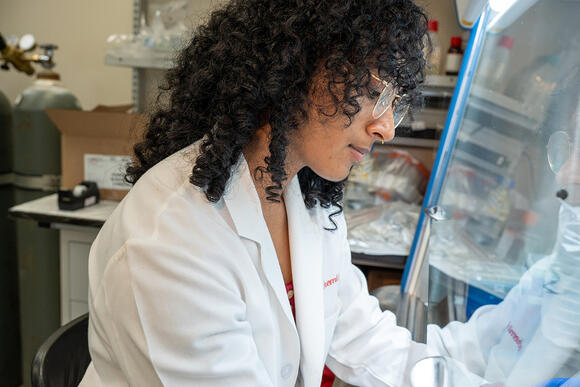
“The generous support from the Rural Cancer Collaborative encourages more involvement from our medical students into the research,” Palle said. “In my experience, after being trained in the labs, a majority of the students want to become physician scientists. I think that helps our next generation of physicians look more scientifically into the disease and disease process and the therapeutic regimens.”
Subash Kairamkonda, Ph.D., a post-doctoral research associate in the Department of Cell Biology and Biochemistry, trains students in lab techniques.
“This program is a good opportunity for both the medical students and us as a lab, because we get to train young minds, and it fills us with more energy,” Kairamkonda said. “Cancer is emerging as the most common disease, irrespective of age. I think it’s important that students get exposed to these kinds of opportunities to understand the disease better.”
“As a medical student, you learn about the disease and medication that needs to be prescribed for patients,” Kairamkonda continued. “But this is where they get the opportunity to learn what actually goes into the discovery of those drugs, and I think that will give them a better appreciation for when they are using a particular pharmacological application.”
Babaria said she appreciates the support and opportunities she’s received throughout the program.
“Being a part of this program made me realize how much I do love research,” Babaria said. “The amount of support that Doctor Palle, Doctor Reedy and Doctor Shen have provided is just amazing.”
Desouza agreed.
“It’s nice to feel supported in what you’re doing. And it also shows that we do have a lot of interest, and we want to be in this space,” Desouza said. “It’s motivating to know that the school is behind you, the Rural Cancer Collaborative is behind you, and that they’re really championing you and your results.”
Support from the Rural Cancer Collaborative is scheduled to continue for the 2027 MSSRP.
“I think this will be a great achievement,” Shen said. “Having this under the Rural Cancer Collaborative umbrella, I believe we can engage more students.”