


The Passion Behind the Progress

While proposals and progress reports keep research projects moving, they rarely capture the passion of the people behind the science. Bringing research to life means showing the human effort, breaking down the trial and error and explaining the real-world impact of what’s happening in the moment. Recently, researchers from Texas Tech University Health Sciences Center (TTUHSC) brought their projects off the page and presented them directly to leadership from the Cancer Prevention and Research Institute of Texas (CPRIT).
“The entire leadership group has come to Lubbock to visit with not only TTUHSC, but also Texas Tech University,” Lance R. McMahon, Ph.D., TTUHSC executive vice president for research and innovation and dean of the Graduate School of Biomedical Sciences, said. “They’ll see all of the great things our two universities are doing together in the cancer prevention, detection, research, treatment and community engagement space.”

Texans voted to create CPRIT in 2007 and invested $3 billion into the fight against cancer. In 2019, voters overwhelmingly approved an additional $3 billion investment into the program. CPRIT is now a $6 billion, 20-year initiative with the goal of finding and funding the best cancer research and prevention opportunities in the state.
“It is always great for us to be able to talk with the people who are actually doing the projects that we are funding,” CPRIT CEO Kristen Doyle said. “It’s one thing to read about it on paper, but to hear about the research from the researcher’s mouth, to see the equipment that we’ve helped buy, and then to have them talk about what this has meant, that is really the impetus for our visit.”
Min Kang, Pharm. D., associate professor in the Department of Cell Biology and Biochemistry, led CPRIT leadership on a tour of TTUHSC’s Pediatric Cancer Research Center.
“CPRIT has had a huge impact on what we are doing here,” Kang said. “Thanks to their generosity, our operation has been working with national groups to make an impact on childhood cancer. One of the biggest is called the Clinical Pharmacology Core Laboratory, which is funded by CPRIT. That lab is supporting the Children’s Oncology Group’s clinical trials as well as the South Plains Oncology Consortium’s clinical trial.”

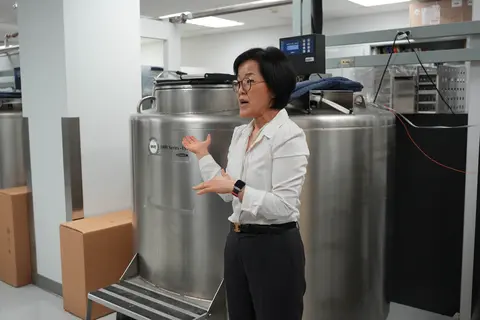
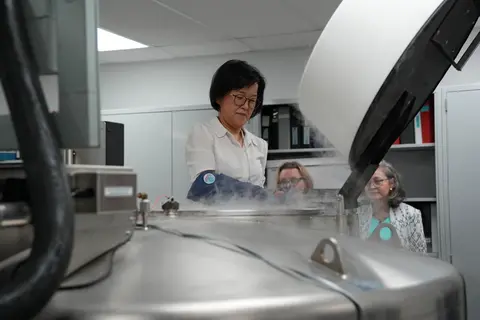
Kang introduced the CPRIT team to graduate students in the lab. Charles Zhu, an M.B./Ph.D. student in the TTUHSC Graduate School of Biomedical Sciences, shared details about his research into triple-negative breast cancer.
“In this field, ALT (alternative lengthening of telomeres) is very understudied,” Zhu said. “I’m trying to identify any ALT models that can be used for any future pre-clinical studies.”
Balakrishna Koneru, Ph.D., assistant professor in the Department of Pediatrics, also shared updates on his research with ALT and osteosarcoma. He received a CPRIT grant for the work in 2025. Koneru explained that ALT is common in aggressive and hard-to-treat cancers, but it creates unique vulnerabilities. He said continued study could lead to better diagnostics and new treatments.
In total, TTUHSC has received nearly $67 million in CPRIT funding. Kang explained that the funds have helped expand access to care and cancer prevention in West Texas.
“That is directly impacting our university, not just a small number of researchers who are receiving those funds,” Kang said. “It has allowed us to screen cancer patients and work on the prevention side of cancer, as well as bringing up the research and clinical trial components at this university.”
Erin Barr, M.D., associate professor of pediatrics at TTUHSC, recently received a CPRIT Recruitment or Retention of Clinical Trialists Award. Barr said the funds will help expand access to pediatric cancer clinical trials in rural areas and develop new phase 1 trials for novel drugs currently being studied at TTUHSC to treat childhood cancers.
“We know that cancer is diagnosed at later stages in our region,” McMahon said. “It’s important for leadership of CPRIT to come see us in person to understand the reality of our largely rural area and the impact that has on detection and treatment.”
TTUHSC serves 121 counties, stretching from the Panhandle through the South Plains and Big Country to the Permian Basin.
Jennifer Kesey, Ph.D., managing director of the TTUHSC Clinical Research Institute, presented to CPRIT leadership about goals to expand clinical trials for adults in West Texas.
“There are over 7,000 new cancer cases annually in this region,” Kesey said. “Many of those patients, unfortunately, are going outside of our region for care in order to have access to innovative therapies that you can achieve through clinical trials.”
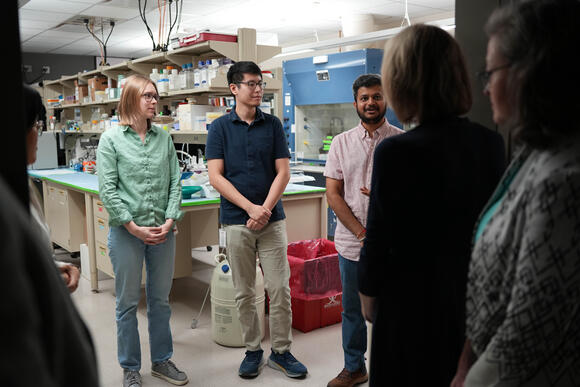
Doyle said another push for CPRIT is to expand infrastructure across the state so that all Texans have the option to participate in clinical trials, providing access to the most innovative treatments possible.
“A lot of what we’re talking about while we’re here is that issue of rural access,” Doyle said. “Access so that people don’t have to make a decision about whether to leave their home to travel to Houston or Dallas. Where they can stay where they are supported by their family, by their communities, and also have access to cutting-edge treatment.”
McMahon said he hoped the CPRIT leadership group came away from the visit understanding TTUHSC’s passion for the mission.
“The mission is very important to us,” McMahon said. “We have tremendous researchers and scientists working at our university not only in fundamental, basic and translational labs, but we are increasingly seeing new clinical investigators and clinician scientists join us to build a translational approach in how we deal with cancer and its effective eradication.”