


TTUHSC Researchers Birth Project to Benefit Moms and Innovate Data Collection

On average, prenatal care for a mother with a risk-free pregnancy consists of 12 to 14 in-person doctor visits. That’s according to the American College of Obstetricians and Gynecologists (ACOG). Of course, the exact number of in-person visits can vary, depending on individual needs.
For those living in areas with a prenatal care provider nearby, a dozen visits to the doctor may not be inconvenient. But for an expectant mother living in Bovina, Texas, it’s a different story.
“We live in the Panhandle, and there are few prenatal care providers in rural areas,” Christine Garner, Ph.D., assistant vice president for research at Texas Tech University Health Science Center (TTUHSC) and associate professor in the Department of Obstetrics and Gynecology, said. “Most of them are really in Potter and Randall counties, which is where Amarillo is situated. So, people have to travel long distances for that care.”
The drive from Bovina to Amarillo is about 83 miles each way. Round trip, that’s nearly three hours of drive time. Just 12 in-person visits mean spending about a day and a half in the car during a 40-week pregnancy. But distance is not the only concern for expectant moms in this area.
Bovina is in Parmer County. It is one of 16 Panhandle counties classified as a maternity care desert according to the “2026 March of Dimes Nowhere to Go: Maternity Care Deserts Across the U.S.” report. Four others are considered to have low access, leaving just six counties in a 26,000-square-mile area that have full access to maternity care.
Living in a maternity care desert presents a number of challenges. Addressing them takes study and time, which is how the VIBRANT MOMS project began.
“That’s what you do in public health,” Stephanie Stroever, Ph.D., assistant professor at the TTUHSC School of Medicine, Department of Medical Education, said. “You start with a needs assessment and then move into problem solving and solutions through additional research or community programming.”
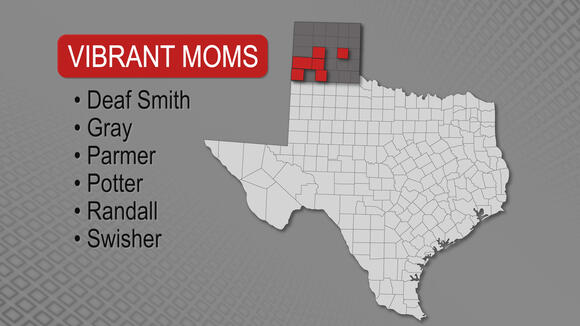
VIBRANT MOMS is funded by the National Institutes of Health (NIH). It focuses on community-engaged research to address maternal health gaps across the Texas Panhandle. Phase I convened a coalition of more than 30 partners to complete a comprehensive community health assessment to understand maternal health needs across the six counties targeted in the study: Deaf Smith, Gray, Parmer, Potter, Randall and Swisher counties.
“We identified lots of barriers that are experienced in our communities by moms,” Garner said. “Some of the major things we identified are delayed entry into prenatal care, lack of insurance, transportation challenges, as well as a higher risk for preeclampsia in this region than the national average.”
Expectant mothers with preeclampsia can experience high blood pressure, high levels of protein in urine that indicate kidney damage or other signs of organ damage. It usually begins after 20 weeks of pregnancy. Left untreated, preeclampsia can lead to serious, even fatal complications for both the mother and baby.
“There are a lot of needs, and we know that,” Stroever said. “Not all of them are feasible to address at this time. And so, we identified preeclampsia as something that we feel we can move the needle on.”
Low-dose aspirin is recommended by major health organizations, such as the ACOG, to prevent preeclampsia in women at high or moderate risk. With a need and an intervention identified, the team also had to study resources in the area.
“You can look at needs all day long, but you have to look at what resources are available to address the needs,” Julie St. John, Dr. P.H., professor at the TTUHSC School of Health Professions, said. “We did what’s called an asset map. We got in my pickup truck, and we drove around these rural communities to see what they look like.”
St. John said they found many communities have locations to buy aspirin. They also identified community organizations willing to be trained to conduct preeclampsia screenings. Building on these findings, VIBRANT MOMS earned a $7.5 million grant from the NIH to support Phase II of the project — the implementation phase.
“Part of what we’re studying with this implementation trial are feasibility, acceptability and appropriateness of these two evidence-based interventions, low-dose aspirin and risk factor screening,” Stroever said. “If we find that it doesn’t seem feasible in our community, it’s not acceptable to them, and it’s not appropriate, then despite all of the best intentions in the world, it’s not going to work.”
Implementation is mainly taking place outside of clinics and with community organizations that were already serving pregnant women in rural areas. It is happening in a stepped process, with five different groups starting implementation at different times. Each instance will take 15 months to complete.
Community health workers (CHWs) will play a significant role in the implementation and sustainability of the VIBRANT MOMS project. CHWs are not doctors; they cannot diagnose or prescribe. They bridge the gap between the community and the healthcare system.
“When we started talking about who community health workers are and what they do, moms really longed and hungered for that social connection and someone that they could trust,” St. John said. “That’s what’s going to make this effective. People want someone to walk alongside them, and they want someone they can trust.”
Trust in CHWs comes from their established presence in a community. They are people who understand the culture, language, and life experiences of the people they serve.
Through the VIBRANT MOMS project, the team identified opportunities for community members to take the official training to become CHWs. They will be able to enroll expectant moms in the study, ask questions about insurance, educate about preeclampsia, screen for risk factors, help make appointments for prenatal care and assist with other social service needs. CHWs also will have touchpoints throughout the pregnancy, ensuring frequent communication with expectant moms about health needs without them having to travel long distances for every answer.
By the end of the project, St. John anticipates having 30 certified CHWs. She also anticipates seeing a ripple effect.
“I think we’re going to see a tremendous amount of impact from the community health worker model being expanded in the Panhandle, because our community partners, many of them serve all 26 counties,” St. John said. “That’s why I think we’ll be able to see improved health outcomes beyond the scope of our project.”
VIBRANT MOMS is also contributing to the field of implementation science. Stroever explained that feasibility has only been validly measured in clinical settings among clinical healthcare workers.
“We are actually validating those measures in a community-based population which doesn’t exist currently,” Stroever said. “We’re hoping that this work will carry forward to other people doing these types of trials so that they know they’re validly measuring what they’re attempting to study and can honestly say, ‘yes, we made a difference.’”
Garner said they have an incredible team of researchers and community partners who each bring different perspectives and skill sets. This creates a complete picture for developing strategies that work and can be sustained long term.
“Working together on this project opens up a lot of doors to identify more ways we can continue our work together in the future and make a difference in our communities.”
For more information about this project, visit vibrantmoms.org or call (806) 414-9972.
Funding acknowledgement and disclaimer: This research was, in part, funded by the National Institutes of Health (NIH) Agreement OT2HL158287. The views and conclusions contained in this document are those of the authors and should not be interpreted as representing the official policies, either expressed or implied, of the NIH.