


Program Overview
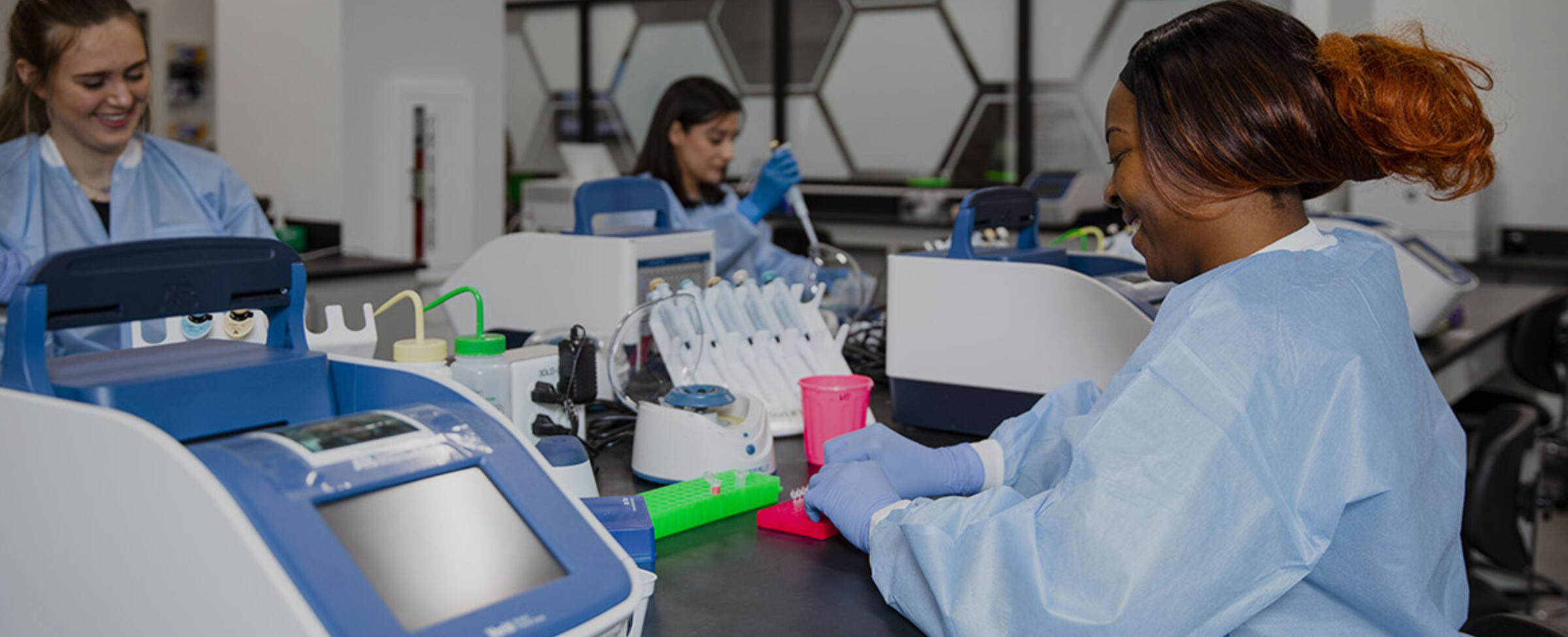
In our state-of-the-art training lab facility, you will develop your skills using some of the most complex gene-testing instruments available. The laboratory space is divided into a preanalytical room (for DNA and RNA isolation) and a post-analytical room (for PCR, DNA sequencing and viral assays). The techniques you will learn are the same as those used by forensic labs and in research and industry facilities. They include:
- DNA and RNA isolation.
- PCR (Polymerase chain reaction).
- Real-Time PCR.
- Sequencing.
- RFLP (Restriction fragment length polymorphism).
- Electrophoresis.
- Next-generation sequencing.
- Pyrosequencing.
The Master of Science in Molecular Pathology program at TTUHSC is accredited by the National Accrediting Agency for Clinical Laboratory Sciences (NAACLS)
NAACLS
5600 N. River Road, Suite 720
Rosemont, IL 60018
Phone: 733-714-8880
Fax: 733-714-8886
For more information, please reach out to the Office of Admissions and Student Affairs at (806) 743-3220 or health.professions@ttuhsc.edu.
- 1 year estimated time to completion
- 28 estimated class size
Curriculum & Coursework
A student must have the permission of the program director to be concurrently enrolled in another university while a student at the Texas Tech University Health Sciences Center.
-
Summer 1 Semester Course Designation Credit Hours
HPMP 5406 Molecular Biology of the Cell 4 hours
HPMP 5300 Research Design and Statistical Analysis 3 hours
HPMP 5100 Issues in Molecular Pathology 1 hour
HPMP 5104 Laboratory Fundamentals 1 hour
Total Hours 9 hours
-
Fall Semester Course Designation Credit Hours
HPMP 5805 Applied Molecular Techniques I 8 hours
HPMP 5407 Principles of Molecular Pathology 4 hours
HPMP 5309 Human Molecular Genetics 3 hours
HPMP 5341 Graduate Research I 3 hours
Total Hours 18 hours
-
Spring Semester Course Designation Credit Hours
HPMP 5408 Applied Molecular Techniques II 4 hours
HPMP 5301 Management of the Molecular Laboratory 3 hours
HPMP 5102 Graduate Seminar 1 hour
HPMP 5441 Graduate Research II 4 hours
HPMP 5342 Clinical Preceptorship 3 hours
Total Hours 15 hours
A student must have the permission of the program director to be concurrently enrolled in another university while a student at the Texas Tech University Health Sciences Center.
-
Combined Total Hours Credit Hours
CURRICULUM TOTAL 42 HOURS
-
Accreditation
The Molecular Pathology Program is accredited by the National Accrediting Agency for Clinical Laboratory Sciences (NAACLS), 5600 N. River Rd, Suite 720, Rosemont, IL 60018 Info@naacls.org / NAACLS
Texas Tech University Health Sciences Center is accredited by the Southern Association of Colleges and Schools Commission on Colleges (SACSCOC) to award baccalaureate, master's, doctoral, and professional degrees. Texas Tech University Health Sciences Center also may offer credentials such as certificates and diplomas at approved degree levels. Questions about the accreditation of Texas Tech University Health Sciences Center may be directed in writing to the Southern Association of Colleges and Schools Commission on Colleges at 1866 Southern Lane, Decatur, GA 30033-4097, by calling (404) 679-4500, or by using information available on SACSCOC's website (www.sacsoc.org).
A member of the Texas Tech University System, TTUHSC has been accredited by the Southern Association of Colleges and Schools Commission on Colleges
(SACSCOC) as a separate institution from Texas Tech University since 2004.
TTUHSC completed its Fifth-Year Interim Report in the spring of 2025. The next reaffirmation of accreditation will occur in 2029.
How to Apply
Online Application
Applicants for the Molecular Pathology program must complete the TTUHSC SHP online application.
Application Fee
A non-refundable $75 application fee is required and may be paid by credit card through the online application system.
If you prefer to pay by check or money order, make it payable to TTUHSC and mail it to:
TTUHSC SHP Admissions and Student Affairs
3601 4th Street, Mail Stop 6294
Lubbock, TX 79430
Your application will move forward in the admissions review process after your application fee has been received.
Transcripts
Paper Transcripts: Transcripts must be in an official sealed envelope by the institution and sent to our mailing address:
TTUHSC SHP Admissions and Student Affairs
3601 4th Street, Mail Stop 6294
Lubbock, TX 79430
Email PDF Transcripts: Submit official electronic transcripts from every college or university attended directly from the institution or an approved third-party transcript service to shp.application@ttuhsc.edu.
Please note:
Do not send transcripts to Texas Tech University, as TTUHSC is a separate institution and doing so will delay application processing.
Official TTUHSC transcripts are not required; official Texas Tech University transcripts are required.
Transcripts from international institutions must include an official course-by-course evaluation from a recognized Foreign Transcript Evaluation Service.
Applicants are responsible for ensuring all required application materials, including updated transcripts, are received by the application deadline.
Admissions Requirements
Official GRE Scores
The GRE is not required for the MP program.
Bachelor's Degree
A Bachelor's Degree is required for admission in addition to the specific prerequisite courses listed.
Minimum GPA
A minimum cumulative GPA of 2.75 and a prerequisite GPA of 2.75 is required to be considered for admission. Applicants must be one of the following:
- Graduate of a NAACLS accredited Medical Laboratory Science Program with a national certification in medical laboratory science
- Graduate of an accredited university with a Bachelor's degree which includes the stated prerequisites
Essay
An essay is required as part of the application.
International Applicants
If you are not a citizen/permanent resident of the United States, please refer to our International Applicants webpage for the additional requirements needed for your application.
Technical Standards
The ability to meet these technical Standards is required for admission to the MP program and must be maintained throughout the terms in which a student is enrolled in the program.
Prerequisite Courses
All prerequisite courses must be complete prior to matriculation. If prerequisite courses have not been completed in the last seven years, program director approval for acceptance of courses may be required.
| Course |
Credit Hours |
|---|---|
| College Algebra |
3 hours |
| General Chemistry - lab required |
8 hours |
| Microbiology |
4 hours |
| Biochemistry |
3-4 hours |
| Genetics |
3-4 hours |
| General Biology |
8 hours |
| Organic Chemistry |
8 hours |
Note: Recommended Courses: Cell Biology and Anatomy & Physiology
* MLS graduates are exempt from some of these prerequisites. Please contact the Office of Admissions and Student Affairs for more information.
Application Process
Applications are considered on a rolling basis for acceptance into the professional program. Individual applications are reviewed once materials have been received; therefore, it is in the applicant's best interest to complete their application, including submission of required documentation, as early as possible. Fulfillment of the basic requirements does not guarantee admission.
Applicants who meet the above-listed requirements and are deemed competitive candidates for admission will be invited to TTUHSC for an interview. The admissions committee selects the most qualified applicants for admission by considering the following: cumulative GPA, prerequisite GPA, interview scores, student essay, and other factors.
Interviews
Admission interviews are granted by the MP admissions committee by invitation only. Applicants are selected for on-campus or online interviews based on a holistic evaluation of their application and supporting documents.
Application Submission Checklist
- Online Application
- Application Fee
- Official Transcripts
- Proof of ASCP Certification (if applicable) for MLS degree
Questions regarding the application process should be directed to the Office of Admissions and Student Affairs. Please contact our office by phone at 806-743-3220 or email at health.professions@ttuhsc.edu
Cost & Aid
Access information about tuition and fees, along with scholarships and financial aid resources, to help you plan and finance your education at TTUHSC.
Tuition & Fees
The following information is not intended to be comprehensive and is subject to change. Tuition, fees, and charges are subject to change by administrative, legislative, or regent action, and changes become effective on the date enacted. The following tuition information should be used only as a guideline for estimating charges.
Scholarships & Financial Aid
Our goal is to make obtaining a college degree within reach by supporting you with financial aid and scholarships programs. TTUHSC relies on a variety of financial aid sources to increase the university's affordability. This may include scholarships, grants, student loans, and waivers. As a student, please know that you and your family have a dedicated financial aid advisor who can assist you with this process.
Student Outcome Data
Molecular Diagnostics Certification
As a graduate of the program, you will be eligible to sit for the American Society for Clinical Pathology (ASCP) national certification exam in Molecular Biology, resulting in the Scientist in Molecular Biology, MB(ASCP) certification.
Outcomes (2023-2025)
| Program Year |
Graduation Rate (%) |
Certification Pass Rate (%) |
Employment Rate (%) |
|---|---|---|---|
| 2022 - 2023 |
100 |
100 |
100 |
| 2023 - 2024 |
100 |
95 |
93 |
| 2024 - 2025 |
100 |
100 |
96 |



-
Molecular Pathology Affiliates
- Sonic Reference Lab - Austin, Texas
- ProPath - Dallas, Texas
- UTSW-BioCenter - Dallas, Texas
- Texas Children's Hospital - Houston, Texas
- M.D. Anderson Cancer Center - Houston, Texas
- Houston Methodist - Houston, Texas
- Baylor Miraca Genetics - Houston, Texas
- Quest Diagnostics med fusion - Lewisville, Texas
- MicroGenDx - Lubbock, Texas
- Methodist Healthcare - San Antonio, Texas
- Baylor Scott & White - Temple, Texas
- Children's Colorado - Denver, Colorado
- Mayo Clinic - Rochester, Minnesota
- TriCore Reference Laboratories - Albuquerque, New Mexico
- Nationwide Children's Hospital - Columbus, Ohio
- Quest Diagnostics Nichols Institute - Chantilly, Virginia
The clinical experiences are structured to provide skill and practice in diagnostic techniques, quality assurance, and interpreting and reporting patient results. The clinical experience is an integral part of the curriculum and students pay regular tuition and fees for enrollment. The preceptorship sites are located throughout the United States. The availability of preceptorship sites for the MP program is based not only on a contractual agreement between the facility providing the preceptorship (usually a hospital, reference laboratory, or university laboratory) and the program but on the ability of the affiliate to accommodate a student in a given semester. Students are expected to be prepared to relocate to complete their assigned preceptorship. The clinical affiliates are committed to teaching and are adequately staffed for service without student assistance. Students are under supervision at all times. Students must not be substituted as regular staff during their Preceptorship. Stipends and scholarships toward a student's education do not imply employment and do not allow student responsibility for direct patient and/or reportable work during scheduled educational periods.
-
As a diagnostic molecular scientist, you will provide a critical service in the molecular diagnostic testing of acquired, inherited and infectious diseases. Your work will enhance the value of clinical laboratory services by providing advanced techniques and applying genetic information to the testing of patient specimens. With the continuing revolution in our understanding of human genomics that is driving new approaches to the therapy and diagnosis of disease, molecular pathology professionals will continue to be presented with dynamic new challenges, including unique kinds of testing, ethical issues, and advanced molecular techniques.
There is a shortage of qualified professionals available to work in this field and employment opportunities can be found in a variety of settings, including:
- Hospital molecular diagnostics laboratories.
- Reference laboratories.
- Biotechnology laboratories and sales.
- Research and development laboratories.
- Forensic laboratories.
- Public health departments.
- Crop science laboratories.
In addition to careers related to human genetic testing, molecular diagnostics specialists are also employed in the fields of animal science and agriculture.
- With an increase in the aging population, and as diagnostic techniques such as prenatal testing for genetic conditions continue to become commonplace, The Bureau of Labor Statistics (BLS) Occupational Outlook Handbook projects that jobs for medical laboratory scientists will increase by 12% to 14% through 2026, faster than average for all professions.
- The BLS projects that job prospects will be best for professionals who complete an accredited education program and earn professional certification.
- For more information about a career as a medical laboratory scientist visit the ASCP website.
-
The Molecular Pathology Program (MP) at Texas Tech University Health Sciences Center is a vigorous and intense program that places specific professional, intellectual, physical, and social requirements and demands on the students enrolled in the program. An objective of this program is to prepare graduates to enter a variety of employment settings and to render care to a wide spectrum of individuals with physical and psychosocial impairments. The technical standards set by the MP program establish the qualities considered necessary for students admitted to the program to achieve the knowledge, skills, and competencies for entry-level practice. Ability to meet these technical standards is required for admission to the MP program and must be maintained throughout the terms a student is enrolled in the program. These standards are subject to amendment based on changes in health care/scope of practice.
Accepted applicants for the MP education program will be required to verify that they understand and meet these technical standards, with or without reasonable accommodations.
In keeping with applicable federal and state law regarding disabilities, we are committed to making reasonable accommodations for individuals with disabilities to enable them to perform successfully in our program. Any student with a disability who is accepted to the MP program must contact the TTUHSC Office of Student Disability Services as soon as possible. The coordinator will evaluate the student, confirm that the stated condition qualifies as a disability under applicable laws, and determine what accommodations are reasonable.
There are three separate and distinct components in the curriculum for the MP program. There is an academic didactic (classroom) component, a laboratory component, and a clinical/fieldwork/preceptorship/ component. Accommodations in place for the didactic component may not be available for the laboratory component, and clinical/fieldwork/preceptorship/components in the curriculum.
To successfully complete didactic, laboratory, and clinical/fieldwork/preceptorship portions in the MP program, an individual must meet the following technical standards with or without reasonable accommodations:
- Mobility:
- The student must have adequate gross mobility in order to maneuver in a timely and safe fashion throughout the department.
- The student must be able to lift his or her arms above shoulder height in order to place or remove items of ten pound or less from shelves.
- The student must be able to bend over at the waist or squat (waist and knees) in order to place and remove items of ten pounds or less from drawers and cabinets.
-
Manual Dexterity:
The student must have adequate fine motor skills to be able to manipulate small objects in a safe and precise manner. Examples would include (but are not limited to) being able to operate a computer keyboard; dial a telephone; handle a pipette, use pipette tips, and reagent vials; manipulate tools and instruments used in the clinical laboratory; collect specimens, and use a pen or pencil in order to communicate effectively in writing for coursework and clinical/fieldwork/preceptorship to ensure patient/client safety.
-
Auditory Acuity
The student must be able to hear well enough to respond to significant sounds in a clinical lab. Examples would include (but are not limited to) being able to hear signals generated from instrumentation that may indicate normal operating status, critical sample value, or equipment malfunction, and being able to hear and follow verbal instruction from a coworker or supervisor in order to ensure patient safety.(National Patient Safety Goals)
-
Verbal Communication Skills:
The student must be able to orally communicate professionally to persons on the telephone or other health care workers listening specifically to the student in person to ensure patient safety. (National Patient Safety Goals)
-
Visual Acuity to read, write, discern colors, and interpret data:
The student must have adequate eyesight such that he/she can recognize and distinguish gradients of color (such as on an qPCR or sequencing assay), read numbers and words either on a video display screen, computer printout, or legible handwriting, and interpret lines and points on graphs and charts to ensure patient safety.
-
Intellectual, Conceptual, Integrative, and Quality Skills:
The student must possess the ability to develop and exhibit organizational problem-solving skills. Specifically, the student must have the ability to measure, calculate, analyze, interpret, synthesize and evaluate data in a short period of time; have the ability to learn to perform duties and assignments in a timely manner while under stress in a variety of settings; exhibit the maturity to accept feedback and demonstrate professional conduct in the classroom, laboratory, and at the preceptorship site.
-
Social Behavior Skills:
Demonstrate respect for individual, social, and cultural differences in fellow students, faculty, staff, patients, clients, and patients’/clients’ families during clinical/fieldwork/ preceptorship/ and academic interactions. Demonstrate flexibility and the ability to adjust to changing situations and uncertainty in academic and clinical/fieldwork/preceptorship situations. Conduct oneself in an ethical and legal manner, demonstrating honesty, integrity, and professionalism in all interactions and situations.
- Mobility:
-
Program Director: Ericka Hendrix, PhD, MB(ASCP)
Request Information
Meet Our Faculty

Program Director, Professor

Professor

Associate Professor

Assistant Professor

Assistant Professor

Assistant Professor

Assistant Professor

Assistant Professor
Contact Us
Office of Admissions and Student Affairs
School of Health Professions - Office of Admissions and Student Affairs
-
Address
3601 4th Street Lubbock
Lubbock, TX 79430
United States
- Phone (806) 743-3220
- Email health.professions@ttuhsc.edu
-
Hours
Mon. - Fri.
8 a.m. - 5 p.m.